

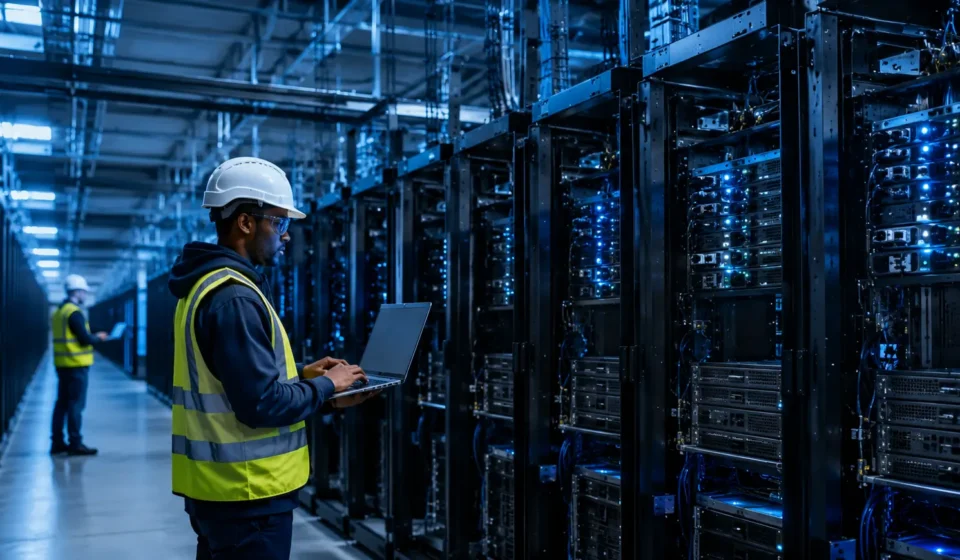

Every time a chatbot answers a question, something invisible happens first. A chip processes the request. A data center keeps the lights on. A cooling system stops the servers from overheating. None of that is free. In fact, someone is billing for every piece of it.
That’s the real story of the AI infrastructure boom. Most headlines focus on flashy AI apps. However, the actual money in this cycle is flowing into the physical and digital plumbing behind those apps. This includes chips, cloud computing, data centers, energy, and networking. In the United States alone, tech companies are expected to spend hundreds of billions of dollars on AI infrastructure in 2026. As a result, that spending is creating very specific winners.
So, this blog breaks down exactly who is profiting from the AI infrastructure boom. It also looks at who is still waiting for a return, and what it means for anyone watching this space as a professional, investor, or business owner.
What Does “AI Infrastructure” Actually Mean?
AI infrastructure refers to everything required to train and run AI models at scale. It is not the chatbot itself. Instead, it is what makes the chatbot possible in the first place. This includes:
- Semiconductors and chips — the processors that do the heavy computational lifting
- Data centers — the physical buildings that house servers running AI workloads
- Cloud platforms — the rented computing power businesses use instead of buying their own hardware
- Networking equipment — the systems that move data between chips, servers, and users
- Power and cooling — the electricity grid upgrades and cooling systems needed to keep massive server farms running
Think of it like the difference between a car and a highway system. The car, or the AI app, gets all the attention. Meanwhile, the highway, gas stations, and traffic infrastructure make the car useful in the first place. This connects closely to the broader shift covered in our piece on the AI finance revolution. There, trillions in capital are being redirected toward exactly this kind of foundational technology.
Who’s Making Real Money Right Now
1. Chipmakers
Companies that design and manufacture AI processors are seeing some of the fastest revenue growth in the industry. After all, every large AI model needs thousands of specialized chips running around the clock. Because of this, demand has consistently outpaced supply.
Example: A company producing AI training chips doesn’t just sell one unit to one customer. Instead, a single data center buildout can require tens of thousands of chips. As a result, one contract can turn into a multi-billion-dollar order. This is why chip manufacturers have become some of the most closely watched companies for anyone doing AI-related stock market analysis.
2. Cloud Computing Providers
The three dominant US cloud providers rent out computing power to businesses. This way, companies don’t have to build their own data centers. As more businesses adopt AI tools, cloud usage goes up. Naturally, so do cloud bills.
Example: Consider a mid-sized retail company building an AI-powered customer service tool. It doesn’t buy servers. Instead, it rents computing capacity from a cloud provider by the hour. Multiply that across thousands of businesses, and cloud providers collect steady, recurring revenue. This happens regardless of which specific AI app wins in the market.
3. Data Center Developers and Operators
Someone has to build the physical buildings where all this computing happens. Therefore, real estate developers, construction firms, and specialized data center operators are experiencing a construction boom. This boom is concentrated in states with cheap land and available power, including Texas, Virginia, and Arizona.
Example: A single hyperscale data center campus can cost several billion dollars to build. It can also take years to complete. Consequently, local construction companies, electrical contractors, and land developers in these regions are seeing direct economic benefits from this buildout.
4. Energy and Utility Companies
AI data centers consume enormous amounts of electricity. In fact, some estimates put a single large facility’s power usage on par with a small city. This is driving utility companies to expand grid capacity. In some cases, it’s even leading them to revive previously retired power plants.
Example: Utility companies near major data center hubs are reporting some of their largest capital investment plans in decades. Specifically, these plans are tied to new AI-related electricity demand.
5. Networking and Hardware Component Makers
High-speed networking equipment connects thousands of chips so they can work together on a single AI task. Similarly, companies making these connectors, switches, and cabling systems are benefiting from the same demand wave as chipmakers. They simply sit one layer down the supply chain.
Who’s Not Making Money Yet
Not every part of the AI ecosystem is profitable. For instance, the application layer, meaning the chatbots, writing tools, and image generators most people interact with directly, is often burning cash rather than making it.
Many AI startups are spending heavily on cloud computing costs just to keep their products running. Meanwhile, they charge subscription prices that don’t yet cover those costs. This mirrors what’s happening across the broader future of work shift toward AI-assisted roles. The tools are becoming essential, but profitability for the companies building them is still catching up to usage.
Similarly, smaller AI hardware startups without major cloud or chip partnerships often struggle to compete. This is because the capital required to build competitive infrastructure runs into the billions.
Why This Matters for the US Economy
The AI infrastructure boom isn’t just a Wall Street story. In fact, it’s showing up in local job markets, construction activity, and even electricity policy across the country. Because states are competing for data center investment, many are offering tax incentives. Meanwhile, skilled trades like electricians and HVAC technicians are seeing increased demand tied directly to this buildout.
It’s also reshaping hiring patterns. For example, roles in data center operations, chip design, and infrastructure engineering are among the fastest-growing categories. We cover this in our breakdown of AI skills employers are actually hiring for, and separately in our look at what the AI engineering job market really wants.
What This Means If You’re Watching From the Outside
If you’re an investor, business owner, or simply curious about this trend, a few practical takeaways stand out:
- Infrastructure spending is a leading indicator. When companies announce massive data center investments, they’re signaling long-term confidence in AI demand.
- Profitability is uneven across the supply chain. Currently, the companies selling the “picks and shovels,” such as chips, cloud capacity, and power, are more consistently profitable than many companies selling AI applications directly to consumers.
- Local economic effects are real. As a result, regions attracting data center investment are seeing tangible job growth in construction, energy, and skilled trades.
- Edge computing is a related trend to watch. Not all AI processing happens in massive data centers. Instead, some of it is shifting closer to the user’s own device. This trend is explained in more depth in our guide on edge AI and why processing is moving to your device.
FAQ: AI Infrastructure Boom
Q: What is the AI infrastructure boom?
It refers to the massive investment currently flowing into the systems that power AI. This includes chips, data centers, cloud computing, and electricity supply, rather than the AI applications themselves.
Q: Who benefits the most from AI infrastructure spending?
Chipmakers, cloud computing providers, data center developers, and energy utility companies are currently seeing the most consistent financial benefits from this spending wave.
Q: Is the AI infrastructure boom sustainable?
That depends on whether AI applications eventually generate enough revenue to justify the infrastructure spending behind them. Either way, infrastructure providers are profitable today, since they get paid whether or not individual AI apps succeed.
Q: Why do AI data centers use so much electricity?
Because training and running large AI models requires thousands of processors running continuously. As a result, this consumes far more power than traditional data centers or standard computing tasks.
Q: Are AI infrastructure jobs only in tech hubs?
No. In fact, much of the recent buildout is happening in states with available land and cheaper electricity. This is creating construction, electrical, and operations jobs outside traditional tech centers.
Final Thoughts
The AI infrastructure boom is where the real, measurable money in this industry currently sits. Chips, cloud platforms, data centers, and power grids are the foundation everything else is built on. Right now, that foundation is where the profits are most consistent. Whether the application layer catches up in profitability remains an open question. Either way, the infrastructure layer is already cashing in.