

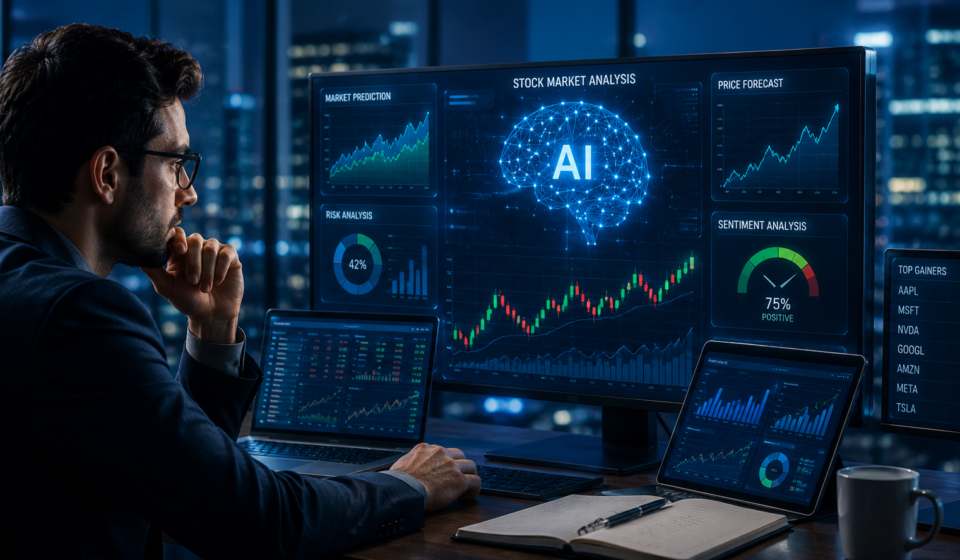
AI for Stock Market Analysis: What It Actually Does and Why Every Investor Should Pay Attention

I used to spend hours every Sunday going through charts, earnings reports, and news headlines before the market opened Monday morning. It was exhausting – and I was still missing things.
Then I started using AI tools for market analysis. Not because I expected them to make me rich overnight, but because I was tired of making decisions based on incomplete information.
What I found surprised me. AI isn’t just faster than manual research. It sees things a human brain simply cannot – patterns across thousands of stocks simultaneously, sentiment shifts in earnings calls, correlations between data sources you would never think to connect.
This guide breaks down exactly how AI is being used in stock market analysis today, which tools are worth your time, and what AI still cannot do (this part matters).
What Does AI Actually Do in Stock Market Analysis?
Before getting into tools and tactics, it helps to understand what AI is actually doing under the hood.
Stock market AI generally works across four areas:
1. Pattern recognition in price data AI models – especially neural networks – can scan historical price charts and identify formations that have predictive value. Head-and-shoulders patterns, breakout setups, support and resistance zones. A human analyst might review 20 charts in an hour. An AI system reviews 5,000.
2. Sentiment analysis from text This is where things get genuinely powerful. AI can read earnings call transcripts, news articles, SEC filings, and even social media posts, then assign a sentiment score. A slight change in how a CEO talks about inventory levels can move a stock – and AI catches it before most humans do.
3. Alternative data processing This was once reserved for hedge funds with nine-figure budgets. Now it is becoming accessible. Alternative data includes things like satellite images of retail parking lots, credit card transaction trends, job posting volumes, and shipping container movements. AI connects these signals to stock performance in ways that traditional analysis cannot.
4. Predictive modeling AI builds probabilistic models- not guarantees, but educated probability ranges – for where a stock or sector might move based on current conditions, historical behavior, and real-time inputs.
Why AI Analysis Is Different From Old-School Technical Analysis
If you have used traditional technical analysis before, you might wonder: is this just the same thing with a fancier name?
It is not.
Traditional technical analysis relies on a fixed set of indicators – RSI, MACD, moving averages, Bollinger Bands. A human analyst decides which ones to look at, applies them, and makes a judgment call. The approach has not changed much since the 1980s.
AI-driven analysis does something fundamentally different. It does not start with a fixed set of rules. It trains on massive amounts of data and learns which patterns have actually predicted price movements historically. It can combine hundreds of variables at once, weight them dynamically, and update its models as new data arrives.
That said, AI analysis is not infallible. It is only as good as the data it trains on – and past patterns do not always repeat.
The Tools Retail Investors Are Actually Using
You do not need to work at a hedge fund to access AI market analysis tools. Here are the ones that are genuinely useful and accessible.

Trade Ideas
One of the most well-known AI screening tools for active traders. Its AI assistant, Holly, runs overnight simulations and generates trade ideas ranked by historical win rates. It is not cheap, but serious traders consider it worth the subscription.
Danelfin
Danelfin uses machine learning to score stocks on a scale of 1 to 10 based on their probability of beating the market over the next 90 days. It analyzes over 900 indicators per stock. The interface is clean and beginner-friendly.
Kavout
Kavout’s K Score system ranks stocks using AI models that process price action, fundamentals, and news sentiment together. It is particularly popular among quant-minded retail investors who want data-driven rankings without building models themselves.
Sentiment analysis tools (like Finviz + StockGeist)
If you want to track how the market is feeling about a specific stock or sector, sentiment trackers powered by NLP (natural language processing) are worth bookmarking. They aggregate news and social media in real time and give you a directional read on crowd psychology.
ChatGPT and Claude (for research)
General-purpose AI assistants are surprisingly useful for breaking down earnings reports, summarizing 10-K filings, or explaining macro concepts quickly. They are not trading tools and should not be used to generate buy or sell signals – but for background research, they save significant time.
How Hedge Funds Use AI (and What That Means for You)
Institutional players have been using AI in markets for years. Understanding what they do helps you see where the real edge lies.
Renaissance Technologies, arguably the most successful quant fund in history, has used statistical models and machine learning to generate returns that have consistently outperformed the market over decades. They do not share how their models work – but the principle is clear: data, patterns, and speed.
Two Sigma, Citadel, and AQR are all running sophisticated AI systems that process alternative data, earnings language, macroeconomic indicators, and order book behavior simultaneously.
Here is the uncomfortable truth: when these systems move on a signal, they move fast. A retail investor relying on the same basic chart patterns everyone else uses is not competing with them – they are in a different game entirely.
The way retail investors can work with this reality rather than against it is to focus on longer time horizons (where algorithmic edge decays), use AI tools for research efficiency rather than trying to out-trade machines, and stay disciplined when short-term volatility is clearly algorithm-driven.
What AI Can See That Humans Cannot
Let me give you a concrete example of where AI sentiment analysis has a genuine edge.
When a company reports earnings, the CEO and CFO talk for 60 to 90 minutes. They use specific language. They describe risks with certain words. They project confidence – or hedge it – in ways that are subtle but measurable.
An AI trained on thousands of past earnings calls can detect:
- Whether the tone of this call is more or less optimistic than the previous one
- Whether the executives are using more hedging language than their peers in the same sector
- Whether specific phrases that historically preceded stock drops are appearing in the script
A human analyst listening to the same call hears the broad narrative. The AI catches the micro-signals.
This same principle applies to news articles, analyst reports, regulatory filings, and even social media. The sheer volume of text that gets generated around publicly traded companies every day is far beyond what any human can read. AI processes all of it.
Where AI Gets It Wrong
This section is just as important as everything above.
AI fails during black swan events. Any model trained on historical data is built on the assumption that the future will look somewhat like the past. When something genuinely unprecedented happens – a pandemic, a major bank failure, a geopolitical shock – the model’s assumptions break down. This is when purely algorithmic systems have blown up historically.
AI does not understand narrative. A product launch that captures cultural attention, a CEO who inspires genuine loyalty, a brand that becomes genuinely beloved – these things matter to stock performance in ways that are hard to quantify. AI can measure some of this through sentiment, but it cannot truly understand it.
AI-generated signals decay. Once a pattern becomes widely known and many systems trade on it, it stops working. The market arbitrages it away. This is why the best quant funds continuously update their models and why any AI tool that claims to have found a permanent edge should be treated with skepticism.
Data quality determines output quality. Garbage in, garbage out. An AI system is only as reliable as the data it processes. Errors in financial data, biased training sets, or outdated information all degrade the output.
A Practical Approach: How to Add AI to Your Investment Process
You do not need to overhaul everything at once. Here is a simple way to start incorporating AI analysis into an existing investment process.
Step 1: Use AI for earnings research Before a company you hold reports earnings, run the transcript from the previous quarter through an AI assistant. Ask it to summarize the key themes, flag any cautious language, and compare tone to the quarter before. This takes ten minutes and gives you better context than most retail investors have.
Step 2: Add a sentiment check to your stock screening Before buying any new position, check a sentiment tool like StockGeist or the news sentiment feed on Finviz. If sentiment is extremely elevated, that is worth noting – not as a reason to avoid the trade, but as a risk factor.
Step 3: Use AI screening for discovery, not execution Tools like Danelfin or Kavout are good for surfacing stocks worth investigating further. Use them as the start of your research, not the end. The AI score tells you which names have interesting data profiles – your own judgment still decides whether to invest.
Step 4: Do not automate your risk management Even if you use AI tools throughout your process, keep humans in control of position sizing, stop losses, and portfolio concentration decisions. These are the areas where model failures cause real financial harm.
Conclusion
AI has permanently changed stock market analysis. The question is no longer whether it will matter – it already does. The question is whether you are using it thoughtfully or ignoring it entirely.
For retail investors, the practical gains are real: faster research, better sentiment data, smarter screening. The risks are also real: over-reliance on signals that worked in the past, misunderstanding what AI can and cannot predict, and using tools without understanding their limitations.
Start small. Pick one part of your research process where AI can genuinely help. Use it consistently. See what it improves.
That is a better starting point than waiting for AI to tell you exactly when to buy and sell – because that day is not coming anytime soon.
Disclaimer: This article is for informational purposes only and does not constitute financial advice. Always conduct your own research before making investment decisions.