



Artificial Intelligence (AI) has become one of the most transformative technologies of the modern era. From automated customer service systems to intelligent data analysis, AI is rapidly changing how businesses operate. As AI technologies continue to evolve, many people are asking an important question: Will AI replace human jobs?
The debate around AI vs human jobs has become increasingly popular as companies adopt automation to improve efficiency and reduce costs. While some experts believe AI will replace many traditional roles, others argue that AI will create new job opportunities and transform the workforce rather than eliminate it.
In this article, we will explore how AI is impacting employment, which jobs are most at risk, which jobs are likely to grow, and how workers can prepare for the future of work.
What Is Artificial Intelligence?

Modern AI technologies power many tools used every day, including:
- ChatGPT for generating text and answering questions
- Google Gemini for advanced AI-powered search and analysis
- Midjourney for generating digital artwork
- Grammarly for improving writing and communication
These systems demonstrate how AI can perform tasks that once required human effort.
Why AI Is Replacing Some Jobs
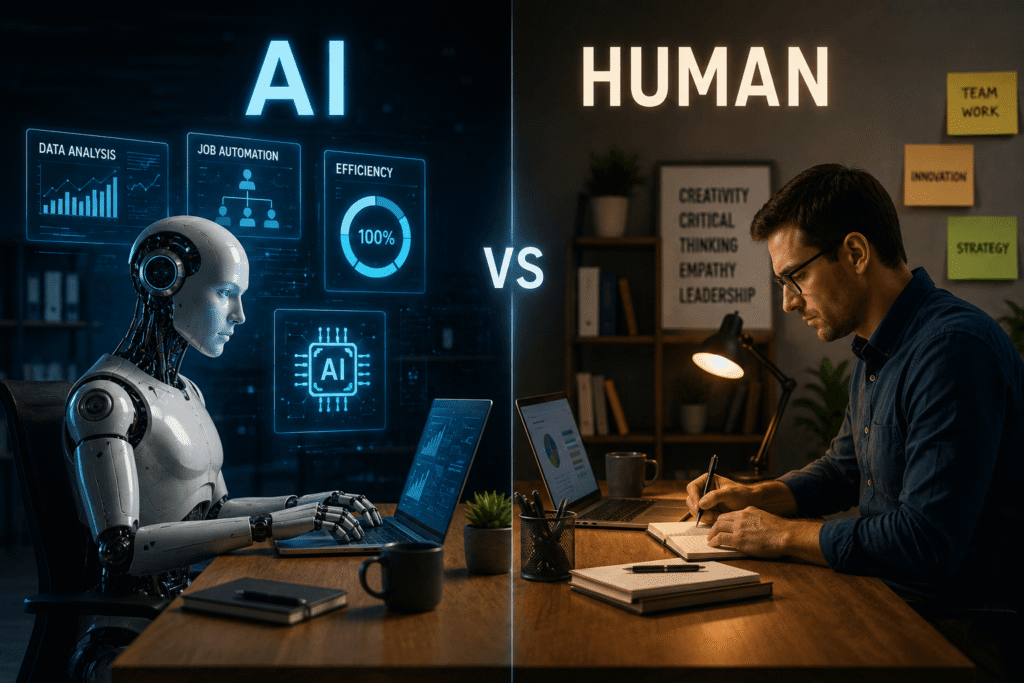
AI is capable of processing large amounts of data, performing repetitive tasks, and operating continuously without fatigue. Because of these advantages, many businesses are using AI to automate certain types of work.
Here are some key reasons why AI is replacing some jobs.
Automation of Repetitive Tasks
Jobs that involve repetitive activities are the easiest to automate. AI systems can perform routine tasks faster and more accurately than humans.
For example:
- Data entry
- Basic customer support
- Manufacturing assembly
- Simple financial calculations
Automation allows companies to increase efficiency while reducing labor costs.
Increased Productivity
AI can analyze large datasets and generate insights in seconds. This capability helps businesses make better decisions quickly.
For instance, AI-powered analytics tools can review customer data, identify trends, and recommend marketing strategies much faster than traditional methods.
Cost Reduction
Implementing AI systems can reduce long-term costs for businesses. Automated systems require less supervision and can operate around the clock.
As a result, many companies are investing in AI solutions to remain competitive in a rapidly evolving digital economy.
Jobs Most Likely to Be Replaced by AI
Although AI offers many advantages, certain jobs are more vulnerable to automation than others. These roles usually involve repetitive processes or predictable tasks.
Some jobs at higher risk include:
Data Entry Clerks
AI software can process and organize data far more efficiently than manual data entry workers.
Customer Service Representatives
Many companies now use AI chatbots to handle basic customer inquiries, reducing the need for large customer support teams.
Manufacturing Workers
Industrial robots and automated machinery are increasingly used in factories to perform repetitive production tasks.
Retail Cashiers
Self-checkout systems and automated payment technologies are reducing the need for traditional cashier roles.
While these changes may lead to job displacement in certain sectors, they also open the door for new types of employment.
Jobs That AI Cannot Replace Easily
Despite its capabilities, AI still has limitations. Many professions require creativity, emotional intelligence, and complex problem-solving, skills that AI cannot fully replicate.
Some jobs that are less likely to be replaced include:
Healthcare Professionals
Doctors, nurses, and medical specialists rely heavily on human judgment, empathy, and personal interaction with patients.
Although AI can assist with diagnosis and medical data analysis, human expertise remains essential.
Creative Professionals
Artists, writers, filmmakers, and designers rely on imagination and creativity, qualities that AI cannot truly replicate.
AI tools can support creative work, but human creativity remains the driving force behind innovation.
Teachers and Educators
Education involves mentorship, emotional understanding, and personalized guidance.
While AI can assist with tutoring and grading, the human element of teaching remains critical.
Leadership Roles
Managers and executives make strategic decisions, lead teams, and navigate complex organizational challenges.
These responsibilities require emotional intelligence and leadership skills that AI cannot easily replace.
New Jobs Created by AI
While AI may eliminate some jobs, it is also creating entirely new career opportunities.
Many industries now require professionals who can develop, manage, and improve AI technologies.
Some emerging careers include:
AI Engineers
AI engineers design and build artificial intelligence systems used in various applications.
Data Scientists
Data scientists analyze large datasets to generate insights that help organizations make better decisions.
AI Ethics Specialists
As AI becomes more powerful, ethical considerations are becoming increasingly important.
AI ethics specialists ensure that AI systems are developed responsibly and fairly.
AI Trainers
AI models must be trained using large datasets. AI trainers help teach systems how to understand language, recognize images, and perform tasks.
These roles demonstrate how technological progress can create new career paths.
How AI Is Changing the Workplace
Rather than completely replacing humans, AI is increasingly working alongside human employees.
This collaboration allows workers to focus on more meaningful and creative tasks while AI handles routine processes.
For example:
- AI can analyze large datasets while humans interpret the results.
- AI tools can generate content ideas while writers refine and expand them.
- AI assistants can automate scheduling while employees focus on strategic planning.
This partnership between humans and AI is likely to define the future of work.
Skills Needed for the AI Era
As AI technology evolves, workers must adapt by developing new skills that complement AI capabilities.
Here are some skills that will become increasingly valuable.
Digital Literacy
Understanding digital tools and AI technologies will be essential for many professions.
Familiarity with AI-powered platforms such as ChatGPT can improve productivity and efficiency.
Creativity
Creative thinking will remain one of the most valuable human skills. AI can assist with generating ideas, but human creativity is necessary to turn those ideas into meaningful solutions.
Emotional Intelligence
Skills such as communication, empathy, and teamwork are difficult for AI systems to replicate.
Professionals who excel in these areas will remain highly valuable in the workforce.
Problem-Solving
Complex problem-solving requires critical thinking and the ability to evaluate multiple perspectives.
These skills are crucial for managing AI systems and interpreting their outputs.
The Future of AI and Human Jobs
The relationship between AI and human employment will continue to evolve.
Experts predict that many jobs will change rather than disappear entirely. Workers may need to learn new tools and adapt their responsibilities as AI becomes integrated into everyday tasks.
For example:
- Marketing professionals may use AI to analyze customer behavior.
- Writers may use AI tools to speed up research and editing.
- Engineers may rely on AI simulations to test designs more efficiently.
In this future, humans and AI will likely collaborate to achieve better results than either could achieve alone.
Should People Be Worried About AI?
It is natural to feel concerned about technological change. However, history shows that new technologies often create more opportunities than they eliminate.
The rise of computers, the internet, and smartphones all transformed industries while also generating millions of new jobs.
Similarly, AI is expected to create new industries, business models, and career opportunities.
The key for workers is to remain adaptable, continue learning, and embrace new technologies.
Conclusion
The debate between AI vs human jobs highlights one of the most important challenges of the modern technological era. While AI has the potential to automate many routine tasks, it is unlikely to completely replace human workers.
Instead, AI will reshape the job market by transforming existing roles and creating new opportunities. Jobs that require creativity, emotional intelligence, and complex decision-making will continue to rely heavily on human skills.
The future workforce will likely consist of humans and AI working together to solve problems, increase productivity, and drive innovation.
Those who learn how to work alongside AI technologies will be best positioned to succeed in the rapidly evolving digital economy.
“A year spent in artificial intelligence is enough to make one believe in God.”