

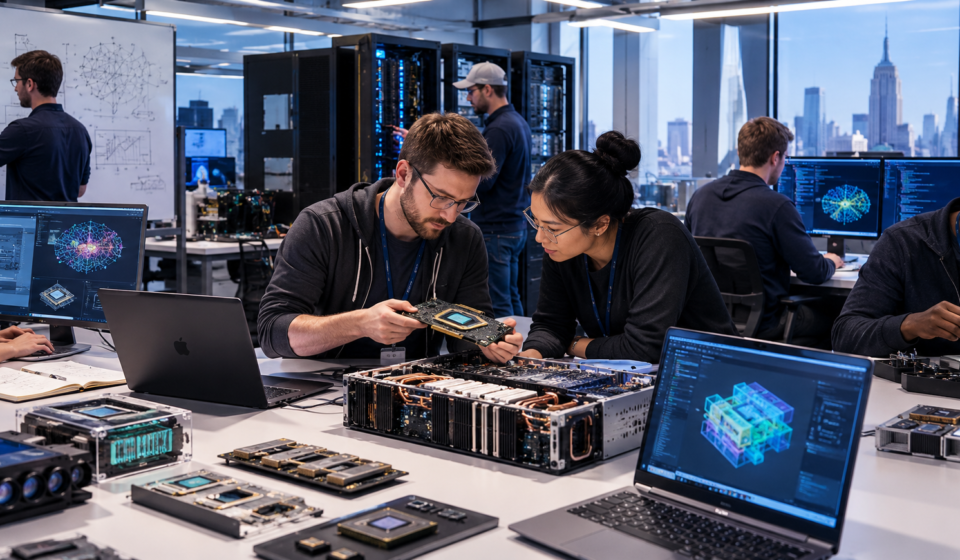

The GPU quietly runs the AI industry. It powers every chatbot response. It powers every AI-generated image. It even powers fraud detection models at US banks. Companies originally built these chips for video games. That era isn’t over. But it’s no longer the whole story.
US data centers now hit power limits. They hit cooling limits. They hit cost limits. GPUs alone can’t solve these problems anymore. Chipmakers, cloud providers, and startups are racing to build something different. They want hardware designed for AI from the ground up, not repurposed from another industry.
This shift ties into a bigger trend. AI is moving processing power away from centralized servers and onto local devices. Our guide on Edge AI Explained: Why AI Is Moving to Your Device covers this shift in detail.
This blog breaks down where AI hardware goes after GPUs. It explains why this matters for American businesses and developers. It also covers what changes to expect in the next few years.
Why GPUs Are No Longer Enough
GPUs became the default AI chip almost by accident. They run thousands of small math operations at once. That’s exactly what training neural networks requires. But three problems now show up at scale.
Power consumption. Large AI data centers in Texas, Virginia, and Arizona now consume electricity that rivals small cities. GPUs use a lot of power by design. Running thousands of them around the clock has become one of the biggest cost centers for AI companies.
Heat and cooling. More powerful chips generate more heat. Some newer data centers now run liquid cooling systems just to stop GPU clusters from overheating. That adds real infrastructure cost.
Supply and cost. A handful of companies control most of the world’s advanced GPU supply. This creates bottlenecks. It creates long wait times. It pushes prices up for smaller companies trying to build AI products. Many US startups now hunt for alternatives because of it.
These pressures push engineers toward new chip designs. Instead of working around GPU limits, they’re solving the problem directly. We cover the people driving this shift in our piece on what the market actually wants from AI engineering talent.
What Comes After GPUs
1. NPUs (Neural Processing Units)
NPUs are chips built specifically to run AI models. They excel at inference, meaning they run an already-trained model instead of training a new one. GPUs handle many types of parallel tasks. NPUs strip that down. They do one thing extremely well: neural network math.
Example: Apple’s Neural Engine sits inside iPhones and Macs. It runs on-device tasks like Face ID, photo recognition, and voice processing without sending data to the cloud. This setup runs faster, protects privacy better, and uses far less power than routing the task through a GPU-based server.
2. TPUs (Tensor Processing Units)
Google designed TPUs for its own AI workloads. Instead of buying GPUs from outside vendors, Google built custom silicon optimized for the exact math its models use most.
Example: Google runs its search ranking systems on TPU clusters. It also runs portions of its Gemini models this way. This gives Google more control over cost and performance than relying on third-party chips.
3. ASICs (Application-Specific Integrated Circuits)
ASICs push specialization even further. A GPU or TPU stays flexible. An ASIC does exactly one job and nothing else. This focus makes it faster and cheaper to run at scale. It also makes it far less adaptable if requirements change.
Example: Groq builds ASIC-style chips specifically for large language model inference. The company claims response times far faster than GPU-based systems running the same models.
4. Neuromorphic Chips
Neuromorphic chips try something different. Instead of copying traditional computer architecture, they mimic how biological brains process information, using something similar to neurons and synapses. These chips still sit mostly in research and early commercial stages. But companies like Intel, with its Loihi chip, bet that brain-inspired designs will eventually handle certain AI tasks using a fraction of the power a GPU needs.
5. Photonic (Light-Based) Computing
Photonic chips move data using light instead of electrons through wires. Light travels faster than electrical signals. It also generates less heat. Because of this, researchers are exploring photonic computing as a way to cut both the speed and energy costs of AI processing. Several US-based startups and major chipmakers are investing heavily here. Widespread commercial use, though, remains a few years out.
6. Wafer-Scale Chips
Manufacturers usually cut chips from a silicon wafer into small individual pieces. Wafer-scale chips flip that approach. They use the entire wafer as one giant processor.
Example: Cerebras Systems builds wafer-scale chips the size of a dinner plate. This design trains large AI models faster because it skips the communication delays that happen when data travels between thousands of separate GPU chips.
Why This Matters for US Businesses
This isn’t just a hardware story for engineers. It carries direct consequences for American companies of every size.
Lower operating costs. Specialized chips like NPUs and ASICs use less power per task. This lowers the electricity bill for any company running AI models at scale, whether that’s a marketing agency running automated ad campaigns or a bank processing millions of fraud checks daily. Our piece on The $10 Trillion AI Finance Revolution Has Already Started explores this broader shift.
Faster local processing. As AI moves onto edge devices, laptops, phones, retail kiosks, and factory sensors can run AI models without a constant connection to a data center. This cuts both latency and cloud costs for businesses in retail, healthcare, and logistics.
New job categories. As hardware diversifies, companies need engineers who understand chip-specific optimization, not just general AI development. This shift is already changing what employers look for. Our coverage of 10 AI Skills That Employers Are Paying For breaks down the details.
Competitive advantage. Companies that adopt cheaper, faster hardware early can price AI-powered products lower than competitors still relying entirely on expensive GPU clusters.
Challenges Still Standing in the Way
None of this happens overnight. Several real obstacles remain.
- Software compatibility. Most AI tools and frameworks run on GPU-based systems. Moving to new chip types often means rewriting or retraining software, which eats up time and engineering resources.
- Manufacturing complexity. Photonic chips and wafer-scale processors remain hard and expensive to manufacture reliably at scale.
- Talent shortage. Few engineers understand both AI models and specialized chip architecture. That shortage slows adoption even when the hardware is ready.
- Standardization. GPUs share a fairly unified software ecosystem. Many new chip types use different tools and languages, which makes switching harder for smaller companies.
What to Expect in the Next Few Years
Most industry watchers expect a hybrid future, not a single winner. GPUs will likely stay dominant for training the largest AI models, since they stay flexible and existing software already supports them well. NPUs and ASICs will take over more inference work, especially in phones, laptops, and edge devices, since they cost less and use power more efficiently for running models rather than building them. Neuromorphic and photonic computing will likely stay niche for a few more years before becoming commercially significant later in the decade.
For US businesses, the practical takeaway stays simple: don’t assume GPUs are the only option going forward. Evaluate your workloads honestly. Training a new model from scratch is a very different job than running a finished model to answer customer questions. Your right hardware choice depends heavily on which one you’re actually doing.
Frequently Asked Questions
Is the GPU becoming obsolete for AI? No. GPUs remain the best option for training large, complex AI models. Inference is what’s changing. When you run an already-trained model, specialized chips like NPUs and ASICs now beat GPUs on speed and cost.
What is the main difference between a GPU and an NPU? A GPU handles graphics, gaming, and AI tasks as a general-purpose chip. An NPU only handles AI math, which makes it more power-efficient but less flexible for other jobs.
Will photonic computing replace electronic chips? Not entirely, and not soon. Photonic computing shows promise for specific AI workloads that need extreme speed and lower heat output. But it remains early-stage technology facing real manufacturing challenges.
Why does AI hardware matter for small businesses, not just big tech? Hardware costs directly affect how much it costs to run AI tools. As specialized chips lower these costs and reach consumer devices, AI features become cheaper and more accessible for small and mid-sized businesses, not just companies with massive data center budgets.
What chip should a business use for building AI products today? Most businesses build on top of existing AI models rather than training new ones from scratch. In that case, your AI provider or cloud platform usually handles the hardware decision for you. The more relevant question becomes choosing the right AI tools and vendors, a topic we cover in AI Tools That Saved My Business $600.
Final Thoughts
The GPU built the current AI era, but it was never designed for the scale AI has reached today. The next phase of AI hardware isn’t about one chip replacing another. It’s about matching the right hardware to the right job: GPUs for heavy training, NPUs and ASICs for fast and cheap inference, and emerging technologies like photonic and neuromorphic computing filling specialized gaps over time.
For US companies building or buying AI tools, understanding this shift is no longer optional. It directly affects your cost, your speed, and how competitive your AI-powered products can become over the next few years.