

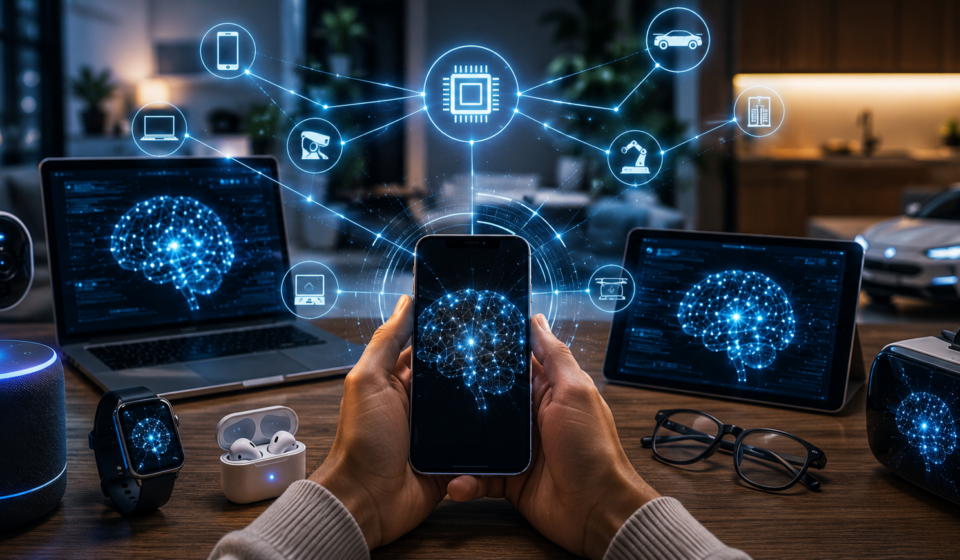

A few years ago, almost every “smart” feature on your phone needed the internet to work. You asked a voice assistant a question. You unlocked your phone with your face. You got a photo suggestion. Each time, the request traveled to a distant data center, waited in line for processing, and came back with an answer. That round trip took time. It drained your data plan. It also sent your personal information to a server you never saw.
That is changing fast. In current era, more AI processing happens right where you are. It runs on the device in your pocket, on your wrist, in your car, or on your kitchen counter. This shift has a name: edge AI. It is one of the most important changes in technology today, and most people have no idea it already runs dozens of times a day on their own devices.
This guide breaks down what edge AI actually is. It covers why companies are racing toward it, and what it means for your privacy, your battery life, and the products you will buy next year.
What Is Edge AI, Really?
Edge AI means running artificial intelligence models directly on a local device instead of sending data to a remote cloud server. The word “edge” refers to the edge of the network, the point closest to the user. The “core,” by contrast, is the centralized cloud infrastructure sitting far away.
Think of it this way. Cloud AI mails a letter to a specialist across the country and waits for a reply. Edge AI keeps that specialist right next to you. It answers instantly, with nothing to mail.
In practice, your smartphone, smartwatch, security camera, car, or even your refrigerator can carry a small but capable AI chip. That chip runs a compact machine learning model, trained ahead of time. It does the thinking locally. The AI part needs no internet connection to function.
Why Is AI Moving From the Cloud to the Device?
A few forces are pushing this shift at the same time, and none of them are fading.
Speed. Sending data to a server and waiting for a reply adds delay, known as latency. A self-driving car detecting a pedestrian cannot afford that delay. Neither can a fitness ring reading your heart rhythm in real time. On-device processing responds in milliseconds instead.
Privacy. Consumers and regulators now watch closely where personal data goes. When your voice command, face scan, or health data never leaves your device, nobody can intercept, store, or misuse it as easily. Apple, Google, and Samsung all treat “processed on device” as a genuine selling point, not just a technical footnote.
Cost and bandwidth. Running billions of AI queries through cloud servers costs a lot. It also demands huge amounts of energy and network capacity. Offloading routine tasks to the device eases the strain on cloud infrastructure and cuts operating costs for the companies building these products.
Reliability. A device that depends entirely on the cloud stops working the moment you lose signal. Edge AI keeps core features running on a plane, in a basement, or in a rural area with spotty coverage.
Better chips. None of this would work without the right hardware. Neural processing units, or NPUs, now come standard in flagship phones, laptops, and even some cars. These specialized chips run AI calculations efficiently, without draining the battery the way a general-purpose processor would.
This mirrors a pattern we already covered in how AI quietly becomes part of everyday routines, often working in the background before people even notice it. We explored that trend in our piece on AI in daily life.
Real Examples of Edge AI You Are Already Using
Edge AI is not a future concept. It already sits inside devices most people own right now.
Smartphone cameras. Your phone detects a face, blurs the background in portrait mode, or brightens a night photo through an on-device AI model. This usually takes under a second, and no cloud connection gets involved.
Voice assistants for basic commands. Setting a timer, turning on a light, or asking for the weather often runs locally on newer devices. More complex questions still route to the cloud.
Wearables and health tracking. Smartwatches and fitness rings analyze your heart rate, sleep stages, and movement directly on the device. This fits a broader wave of AI-powered health devices, similar to the smart sleep and recovery tools we cover in our AI for better sleep guide.
Smart security cameras. Modern home security cameras distinguish between a person, a car, and a stray cat without sending every frame to a server. That means faster alerts and less footage stored off-site.
Cars. Advanced driver assistance systems, including lane detection and automatic braking, rely on edge AI. There is no time to wait for a cloud response when a hazard appears on the road.
Retail and point-of-sale systems. Some checkout and inventory systems now use on-device computer vision to track stock levels in real time. This extends a trend we cover in how AI is already reshaping online stores and e-commerce operations.
The Challenges Nobody Talks About
Edge AI is not a perfect solution. The trade-offs matter too.
Device hardware has limits. A phone or a smart camera holds far less processing power than a data center. That means edge AI models usually run smaller and less capable than their cloud counterparts. Companies solve this with a hybrid approach: simple, fast tasks run locally, while complex reasoning still goes to the cloud.
Battery life stays a constant balancing act. Running AI locally uses power, so manufacturers must optimize carefully. Otherwise, features drain the battery faster than users expect.
Updating models takes more work. A cloud-based AI model improves centrally and reaches every user instantly. An on-device model usually needs a software update pushed out to millions of individual devices, and that rollout takes longer.
Edge AI vs Cloud AI: A Simple Comparison
The two are not competitors. They work as teammates. Cloud AI handles tasks that need massive computing power, like generating detailed images or holding a long, complex conversation. Edge AI handles tasks that need speed, privacy, and reliability, like unlocking your phone or detecting a fall from a smartwatch.
Most modern devices now use both. A phone might use edge AI to recognize your voice command, then send the actual question to the cloud when it needs a detailed answer. This layered approach is quickly becoming the standard architecture across consumer technology. Businesses use a similar layered strategy when choosing the right AI tools for growth.
Solution: How to Make the Most of Edge AI Today
Want to actually benefit from this shift instead of just reading about it? A few practical steps help.
Check your device settings for on-device processing options. Many phones let you choose whether certain AI features, like transcription or photo tagging, run locally or in the cloud. Local processing often improves speed and privacy at the same time.
Prioritize newer devices with dedicated AI chips if privacy and speed matter to you. A phone or laptop with a strong NPU handles far more tasks without an internet connection than an older model can.
Keep your software updated. On-device AI models improve through updates rather than instant cloud changes, so staying current keeps your accuracy and security current too.
Understand what data stays local versus what leaves the device. Most manufacturers now disclose this in their privacy documentation. It only takes a few minutes to check.
FAQ
Is edge AI the same as on-device AI? Yes, people use these terms interchangeably. Both describe AI processing that happens directly on a local device rather than a remote server.
Does edge AI work without the internet? Yes, for tasks the device handles locally. More complex requests may still need a connection if the device relies on the cloud for that feature.
Is edge AI more secure than cloud AI? It reduces certain risks, since sensitive data does not need to travel over the internet or sit on a remote server. Security still depends on how well you protect the device itself.
Which companies are leading in edge AI? Apple, Google, Samsung, Qualcomm, and Nvidia rank among the major players building AI chips and software for on-device processing.
Will edge AI replace cloud AI? Not entirely. The two work together. Edge AI handles fast, private, everyday tasks, while cloud AI handles heavier computing needs like advanced image generation or in-depth analysis.
Final Thoughts
Edge AI marks a quiet but significant shift in how artificial intelligence actually works in daily life. The thinking now happens right where you are, on your phone, your watch, your car, and soon, nearly every connected device you own. As chips grow more powerful and models grow more efficient, expect this trend to accelerate rather than slow down. Smart devices no longer just talk to the cloud. They are starting to think for themselves.