



Everyone wants to work at OpenAI right now. The company behind ChatGPT, GPT-4o, and Sora has become the most talked-about employer in tech. But most people applying have no idea what OpenAI actually looks for, what the roles pay in real numbers, or why thousands of strong candidates get rejected every single cycle.
This is not a list of job titles you can find on their careers page. This is the behind-the-scenes reality of what it takes to land a role at OpenAI in 2026, what the process looks like from the inside, and what you should do differently if you want to stop getting auto-rejected.
Why OpenAI Hiring Is Nothing Like Other Tech Companies
Most people assume OpenAI hires the same way Google or Meta does. Strong resume, crack the coding interview, negotiate the offer. That model does not apply here.
OpenAI is a mission-driven research organization that also happens to be one of the fastest-growing tech companies in history. That combination creates a hiring culture that is genuinely unusual. They are not just looking for people who can do the job. They are looking for people who believe the work matters enough to operate under pressure, uncertainty, and a pace that most corporate environments never experience.
The result is that a candidate with a Stanford PhD who interviews perfectly on technical skills can get passed over for someone with a non-traditional background who clearly understands why safe AI development is the defining challenge of this decade.
This shift in what companies value is something we have been tracking closely at AI Overview Search. The AI skills employers are actually hiring for have changed dramatically in the past 18 months, and OpenAI is leading that shift.
The Real OpenAI Career Categories in 2026
OpenAI’s open roles fall into roughly six areas. Understanding which one fits you is the first decision that matters.
Research and Safety Science
This is the core of what OpenAI does. Researchers in alignment, interpretability, and foundational model development. These roles are extremely competitive and almost always require publication history, graduate-level work, or demonstrated project experience in ML. If you are applying here without any of those, you are not going to get through the screening.
The good news is that the definition of “research experience” is expanding. Independent projects, open-source contributions to model work, and technical blog posts that demonstrate deep understanding of transformer architectures are now taken seriously in a way they were not three years ago.
Product and Applied AI
This is where the growth is happening in 2026. OpenAI’s consumer and enterprise products have scaled faster than the org expected, and they are hiring product managers, applied AI engineers, and product designers who understand both the technical limitations of current models and the user behavior patterns that determine whether a product succeeds.
The mistake most candidates make here is leading with their product experience from traditional software companies. OpenAI product roles require you to understand what the model can and cannot do, how hallucination affects user trust, and how to design for systems that are probabilistic rather than deterministic.
Go-to-Market, Sales, and Partnerships
OpenAI has built enterprise products like ChatGPT Enterprise and the API, and they need people who can sell and grow those relationships. These roles are less visible in the conversation about AI careers, but they are real, they pay competitively, and they are genuinely impactful.
If you have a background in enterprise software sales, partnerships, or business development and you understand what AI tools actually do for business workflows, this is the fastest path into OpenAI for a non-technical candidate. We have covered how AI is transforming business operations in ways that make this kind of bridge role increasingly valuable.
Policy, Trust, and Safety Operations
Fewer people know these roles exist. OpenAI has entire teams dedicated to content policy, use case evaluation, government relations, and trust and safety operations. These are not research roles. They require people who understand law, policy, ethics, and the real-world consequences of AI systems at scale.
If you have worked in content moderation, public policy, legal, or civil society organizations, these roles are a genuine entry point that most candidates overlook completely.
Infrastructure and Engineering
Behind every ChatGPT conversation is an infrastructure problem that most companies have never had to solve. OpenAI runs models at a scale that requires custom solutions at every layer. Software engineers, ML infrastructure specialists, and data engineers who want to work on systems that are genuinely novel will find this environment unlike anywhere else.
Operations, Finance, and Business Functions
Recruiting, finance, legal, HR, communications. These exist at OpenAI and they are not afterthoughts. The company needs operational excellence to function, and they hire people for these roles who are not just competent at the function but genuinely excited about the mission.
What the OpenAI Application Process Actually Looks Like
Here is the process as it runs in 2026 for most roles.
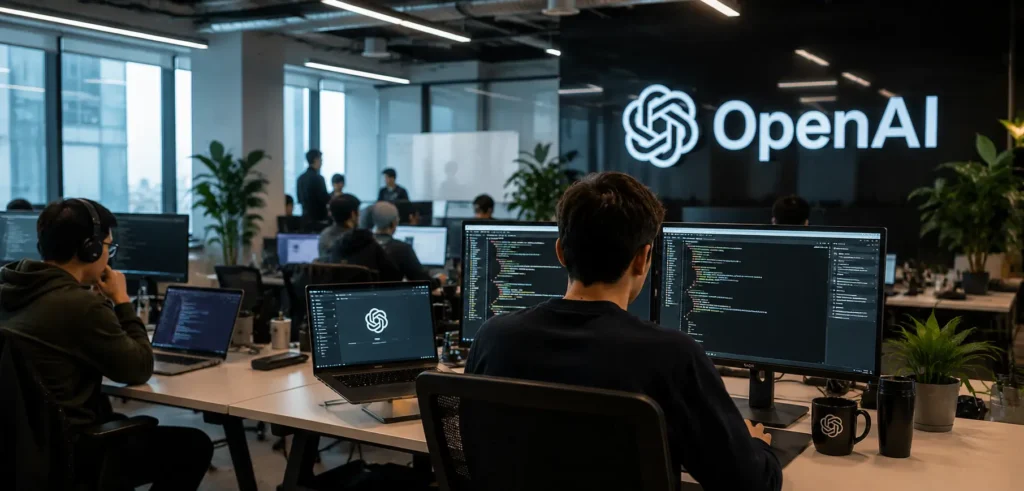
You apply through the careers page. If your application passes the initial review, you get a recruiter screen. That screen is not a formality. The recruiter is assessing whether you understand what OpenAI is actually trying to do, not just whether you want a prestigious job.
After the recruiter screen, technical roles move into a skills assessment or take-home project. This is where most candidates stall. The assessment is designed to evaluate how you think through ambiguous problems, not whether you can solve a textbook question under a timer.
From there, the process moves to a panel interview round with team members and hiring managers. OpenAI uses structured interviews but they leave significant room for open-ended discussion. They want to see how you reason, not just whether you arrive at the right answer.
Final rounds often include a values and mission conversation. This is real and it matters. If you cannot speak to why safe AI development matters to you personally and specifically, you will not pass this stage even if your technical performance was strong.
The full process typically runs four to eight weeks. Offers move faster for senior roles where there is urgency and slower for research positions where the bar is higher and the decision is more deliberate.
The Salary Reality Nobody Publishes
OpenAI pays at the top of the market. But the structure of that compensation is different from what most people expect.
Total compensation for mid-level roles sits between $250,000 and $400,000 in combined salary and equity when you include refreshers. Senior research scientists and principal engineers are above $500,000 in total comp. Leadership roles can go significantly higher.
The equity component is in the form of profit participation units rather than traditional stock options. This matters because OpenAI is a capped-profit company with a complex corporate structure. The value of that equity depends on outcomes that are genuinely uncertain in ways that differ from typical startup RSUs or big tech stock grants.
The honest assessment is that OpenAI compensation is exceptional, but you should go in understanding the equity structure, not just the headline numbers. If you are evaluating this compared to a FAANG offer, the certainty of public company equity versus capped-profit units is a real consideration.
The Skills That Are Actually Getting People Hired Right Now
We looked at what has changed in the last 12 months across hundreds of AI company hiring patterns, and OpenAI is following the broader trend we have documented in our coverage of AI skills employers are paying for.
Prompt engineering as a standalone skill is no longer a differentiator. Everyone has done it. What matters now is demonstrated ability to evaluate model outputs, understand failure modes, and build systems around AI components that are reliable in production.
Alignment and interpretability knowledge is genuinely valued even in non-research roles. If you have read the major papers, understand RLHF, and can discuss constitutional AI or mechanistic interpretability at a conceptual level, you stand out from candidates who only know how to use the tools.
Domain expertise combined with AI application is the sweet spot for product and applied roles. A nurse who deeply understands what AI can and cannot do safely in clinical workflows is more interesting to OpenAI than a generic product manager who has built AI features.
Communication and writing ability matter more than most technical roles require. OpenAI writes a lot. Research papers, policy documents, internal memos, product documentation. Clear writing is treated as a signal of clear thinking.
The Mistakes That Are Killing Most Applications
The first mistake is applying without reading. OpenAI publishes extensively. Their research papers, their policy documents, their system cards, their blog posts. Candidates who come to interviews without having read the work signal immediately that they want the brand, not the mission.
The second mistake is treating OpenAI like a big tech job. The interview is not LeetCode practice and salary negotiation. It is a genuine conversation about what you believe and what you want to build. Candidates who optimize purely for performance come across as exactly that.
The third mistake is underselling unconventional backgrounds. OpenAI has hired philosophers, lawyers, former teachers, military veterans, and journalists into meaningful roles. If your path is not traditional, do not apologize for it. Explain how it connects to the work they are doing.
The fourth mistake is ignoring the newer teams. Everyone wants safety research or GPT engineering. Most people do not look at the policy teams, the trust and safety operations teams, or the enterprise product teams. Those roles have more openings, less competition, and direct paths into a company that most people spend years trying to enter.
If you are working on building skills to get to this level, our breakdown of how beginners are earning with AI and what AI agents are doing to careers gives you practical context for where the industry is heading.
Remote Work and Location Reality in 2026
OpenAI is primarily San Francisco-based and has become more intentional about in-person work over the last year. Most research and senior roles have an expectation of significant time in the San Francisco office.
There are fully remote roles, primarily in go-to-market, policy, and some engineering functions. But if you are applying with the expectation that this will be a fully distributed position at the research or product level, you should verify that assumption before going deep in the process.
International hiring exists but it is limited. OpenAI has opened some roles in the UK and Europe, primarily tied to their policy and government relations expansion. The majority of headcount growth is still US-based.
The Honest Advice for Getting From Interested to Hired
Start with what you know. Do not try to become a machine learning researcher if your background is not there. Find the intersection between what you are genuinely good at and what OpenAI needs. That intersection exists for more people than think it does.
Build something real. Not a tutorial project. A real application, a real analysis, a real piece of writing that demonstrates how you think about AI in your domain. Put it somewhere people can see it.
Read the work. Start with OpenAI’s GPT-4 technical report, their safety papers, and their usage policy documentation. Then read the criticism of their work too. Being able to engage with both sides of the conversation about what they are doing is a signal of serious engagement.
Talk to people who work there. LinkedIn exists. People respond to genuine, specific outreach. Not “I want to work at OpenAI, can we chat” but “I read your paper on X, I had a question about how you approached Y, would you be willing to talk for 20 minutes.” One conversation with someone inside the org is worth more than fifty cold applications.
Apply when you are ready, not when you are hopeful. OpenAI tracks applications. A rejected application that was weak does not necessarily block a future one, but starting with your best version matters.
This is the moment in AI development where the companies doing the most important work are hiring the people who will shape what comes next. Understanding that and positioning yourself clearly within it is what separates candidates who get interviews from candidates who get hired.
For more on where AI careers, tools, and the industry are heading, explore what we cover at AI Overview Search across AI in Business, AI Tools and Reviews, and AI in Education.