

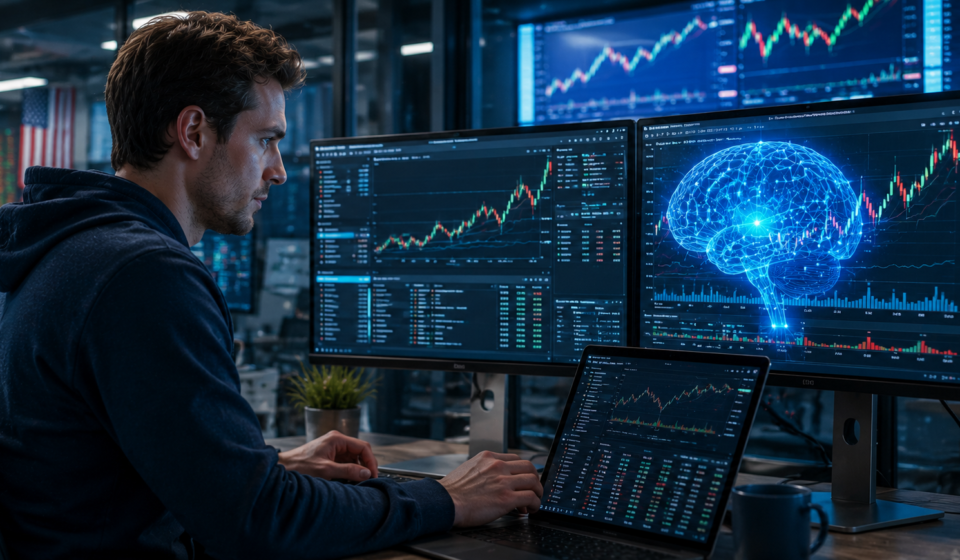

Options trading has always demanded a mix of math, timing, and nerve. A single contract can move based on price, volatility, time decay, and interest rates all at once, which is why so many new traders get overwhelmed before they place their first trade. Over the past few years, artificial intelligence has started to change that equation.
It is not replacing the trader, but it is removing a lot of the guesswork that used to eat up hours of research every week.
Across the United States, retail traders, financial advisors, and even institutional desks are now using AI tools to scan option chains, model volatility, and flag setups that would take a human analyst far longer to find manually.
This article breaks down what AI for option trading actually looks like in practice, where it helps the most, and what limitations traders still need to keep in mind.
What AI Actually Does in Options Trading
AI in options trading generally falls into a few core categories. The first is pattern recognition. Machine learning models can process years of historical price and volatility data to identify recurring setups, such as how a stock tends to behave before earnings or how implied volatility typically contracts after a major news event.
The second is real-time scanning. Instead of manually checking dozens of tickers for unusual options activity, AI tools can scan the entire market and surface contracts with abnormal volume, open interest changes, or skew shifts within seconds.
The third category is risk modeling. Options have several moving variables, commonly referred to as the Greeks: delta, gamma, theta, vega, and rho.
AI systems can calculate how a position’s risk profile will shift under different price and volatility scenarios much faster than a spreadsheet, which helps traders adjust strategies before conditions change against them.
Finally, Some platforms use AI to recommend option structures, such as spreads, straddles, or iron condors, based on a trader’s outlook and risk tolerance.
This does not mean the AI is making the final call, but it narrows down choices that would otherwise require manually testing dozens of combinations.
Why Options Traders Are Turning to AI
Options pricing is driven by probability, not certainty. A contract’s value depends on how the market prices the likelihood of future movement, and that pricing shifts constantly.
Traditional research methods, reading news, checking charts, and running basic calculators, simply cannot keep pace with how fast implied volatility and open interest can change during a trading session.
AI tools compress that research time significantly. A model that would take a trader an hour to calculate manually, such as the probability of a stock closing above a certain strike price by expiration, can be generated instantly.
That speed matters most during high volatility periods, like earnings season or major economic announcements, when option prices can swing dramatically within minutes.
There is also a data volume problem. The U.S. options market alone processes millions of contracts across thousands of underlying stocks and ETFs every trading day. No individual trader can track that volume of data manually.
AI systems built for this purpose can filter through it and highlight only the contracts that match a trader’s specific criteria, whether that is unusual volume, high implied volatility rank, or a particular expiration window.
Common AI Tools Used by Options Traders

Several types of tools have become common among U.S.-based options traders. Options flow scanners use AI to detect large or unusual trades placed by institutional investors, sometimes referred to as “smart money” trades.
Volatility prediction tools use machine learning to forecast how implied volatility might behave around earnings or economic events. Backtesting platforms let traders simulate a strategy across years of historical data in minutes instead of days, using AI to identify which variables actually affected performance.
Some brokerages have also started integrating AI-driven trade idea generators directly into their platforms, giving retail traders access to research tools that were previously limited to institutional desks.
None of these tools guarantee profitable trades. They are designed to speed up research and highlight opportunities a trader might otherwise miss, similar to how AI tools are reshaping research and decision-making across other areas of AI in Business.
Where AI Still Falls Short
AI models are only as good as the data they are trained on, and options markets can behave unpredictably during black swan events, sudden geopolitical shocks, or liquidity crunches that have no clean historical precedent. A model trained on years of “normal” market behavior can struggle when conditions break from historical patterns entirely.
There is also the risk of overreliance. Some traders treat AI-generated signals as guarantees rather than probabilities, which can lead to oversized positions or ignoring basic risk management. Options trading already carries the risk of total loss on a contract, and no AI tool changes that fundamental math.
Traders still need to understand position sizing, expiration risk, and how assignment works before placing trades, regardless of how sophisticated their tools are.
Cost is another factor. Many of the more advanced AI options platforms charge monthly subscription fees that can run into hundreds of dollars, which may not be worth it for traders with smaller accounts or infrequent trading activity.
How to Get Started With Options Trading Using AI
For traders new to this space, the most practical starting point is not a complex AI platform but understanding basic options mechanics first. AI tools work best when the trader already understands what they are looking at, since a tool that flags “unusual call volume” is only useful if the trader knows what that actually implies about market sentiment.
From there, many traders start with free or low-cost tools that offer AI-assisted screening before moving to paid platforms with deeper analytics. It also helps to treat AI output as one input among several, rather than a standalone signal.
Cross-checking AI-generated ideas against fundamental analysis, broader market trends, and personal risk tolerance remains a reasonable approach, one that mirrors how AI is increasingly used to support decisions in AI-Powered Financial Planning and AI for Stock Market Analysis more broadly.
The Bottom Line
AI has become a genuine research advantage for options traders in the United States, mainly by compressing the time it takes to analyze volatility, scan for unusual activity, and model risk across a position. It is a tool for speed and pattern detection, not a replacement for understanding how options actually work.
Traders who combine AI-driven research with solid risk management are in a much stronger position than those relying on either approach alone.
As AI tools continue to mature across the broader financial and marketing landscape, covered in more detail across our AI Tools & Reviews section, options trading is likely to remain one of the more data-intensive areas where these tools show clear, practical value.