

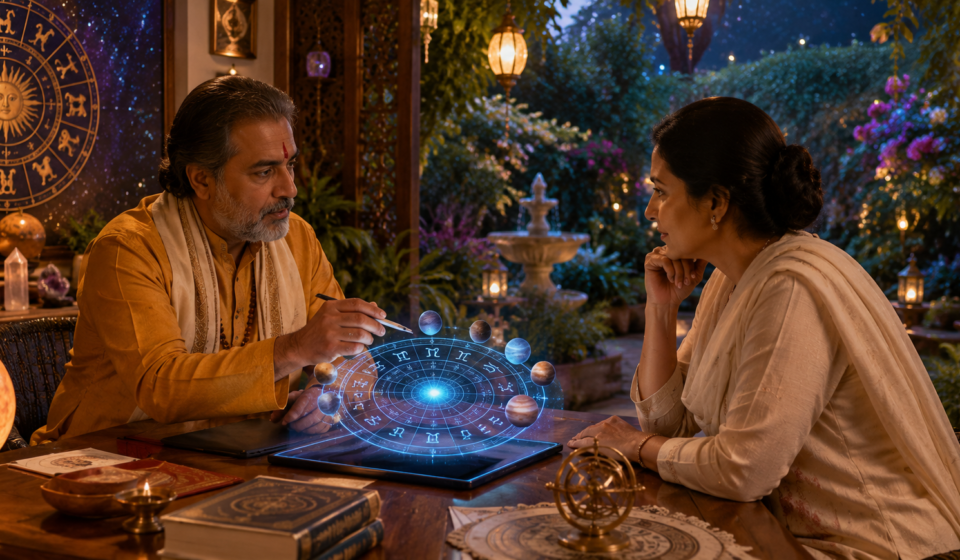

Millions of Americans check their horoscope every morning. It might be a quick glance at a daily app, a deep dive into a birth chart reading, or a casual scroll through zodiac content on social media. Whatever the format, astrology is not a niche interest. It is mainstream. And now, artificial intelligence has quietly stepped into the same space.
The question people are genuinely asking is straightforward: does AI actually make astrology smarter, or is it just the same content wrapped in a tech-sounding package? This article gives you a plain, honest answer – no hype, no overselling.
If you want a broader picture of how AI is reshaping everyday tools, it helps to stay current with the latest AI trends and insights at AI Overview Search.
What Is AI Actually Doing in Astrology?
Traditional astrology relies on three pieces of information: your birth date, birth time, and birth location. These are used to generate a natal chart, which maps out the position of planets at the exact moment you were born. Interpreting that chart – understanding what those positions mean for your personality, relationships, and life direction – has always required years of training.
AI does not change what astrology is. It changes how fast and how completely the data gets processed. Modern astrology apps powered by machine learning can analyze thousands of chart combinations in seconds, cross-reference established interpretations from multiple traditions, and deliver a personalized reading without any human astrologer involved.
Some platforms go further. They use pattern recognition across large datasets of birth charts and user-reported life outcomes to find correlations. The idea is that if enough people sharing a specific planetary configuration also report similar life patterns, AI can surface those tendencies as part of your reading.
This is essentially what predictive AI does in many other areas of life. If you want to understand the mechanics behind this kind of pattern-matching, AI Is Reading Your Mind: How Predictive AI Works in Daily Apps breaks it down clearly.
What AI Does Well in This Space
Instant, Accurate Chart Calculations
Getting a detailed natal chart used to require booking time with a professional astrologer and waiting for them to do the calculations manually or through specialized software. Apps like Co-Star, Sanctuary, and Pattern now handle this instantly. The astronomical calculations are precise, and the output is immediate. For anyone who wants to explore astrology without paying for a session, this is a genuine improvement.
Personalized Daily Insights
Generic sun sign horoscopes – the kind written for everyone born in a given month – have always been a rough approximation at best. AI-powered platforms can pull your specific chart, check which planetary transits are active on a given day, and generate an insight that actually reflects your individual configuration. The output is more specific, and for people who use astrology as a daily reflection tool, that specificity matters.
Compatibility Analysis
Relationship compatibility – comparing two birth charts to assess how they interact – is one of the most requested services in traditional astrology. The process, called synastry, involves comparing every planet and house in both charts. An experienced astrologer can spend an hour on this. AI does it in seconds, producing a layered compatibility report that covers the same ground. Whether the interpretation is as nuanced is a different question, but the depth of data processed is unmatched.
Pattern Recognition Over Time
This is where AI genuinely adds something beyond speed. By analyzing when certain planetary configurations occurred historically alongside user-reported experiences, some platforms attempt to surface recurring themes – not as certainties, but as probabilities. Think of it like weather forecasting. Not a guarantee, but a useful signal. Understanding this kind of probabilistic thinking helps if you also follow how AI is used in stock market analysis – the underlying logic is similar.
What AI Cannot Do – and You Should Know This
Here is the honest part. AI in astrology has real limits, and some platforms are not upfront about them.
First, astrology itself is not a predictive science in any measurable, peer-reviewed sense. No study has confirmed that planetary positions cause life events. That does not mean the practice has no value – many people find genuine self-reflection and meaning through it – but it does mean that AI layered on top of astrology is pattern-matching within a belief framework, not forecasting the future the way a model forecasts economic trends or weather.
Second, the quality of an AI astrology reading depends entirely on its training data and the astrological tradition it follows. Two apps analyzing the same birth chart can produce noticeably different readings if they draw from different sources.
Third, a good human astrologer does something AI cannot replicate right now: they listen. They adjust their interpretation based on what you share about your life, your current situation, your questions. AI delivers a report. A skilled astrologer holds a conversation. Those are different things.
Benefits vs. Drawbacks
| Benefit | Drawback |
|---|---|
| Speed and Accessibility: Full chart generation in seconds, free or low-cost. | Depth: Lacks the conversational nuance of a human astrologer. |
| Personalization: Goes beyond generic sun sign content. | Consistency: Different platforms produce different readings for the same chart. |
| Scale: Can analyze thousands of chart combinations simultaneously. | Accuracy: AI cannot verify which interpretations actually hold up in practice. |
| Availability: Available 24/7 on any device, no appointment needed. | Privacy: Birth date, time, and location are sensitive personal data points. |
Why Americans Are Drawn to AI Astrology Right Now
There is a cultural reason this is gaining traction in the US specifically. Americans have always had a practical relationship with self-improvement tools. Therapy, journaling, personality frameworks, life coaching – these are all mainstream. Astrology slots into that same category for a large segment of the population: not necessarily as a belief in fate, but as a framework for reflection and self-understanding.
AI makes that framework more accessible and more specific. Instead of reading a column written for all Scorpios born across a 30-day window, you get insights built around your unique chart – your rising sign, moon placement, and current planetary cycles. For someone who already finds value in astrological thinking, that specificity feels meaningful.
Younger Americans – particularly Millennials and Gen Z – are driving this adoption. Many treat AI astrology tools the same way they treat any AI product: with curiosity, reasonable skepticism, and a willingness to keep using it if it adds something to their day. If you want to understand how this generation is approaching AI tools more broadly, How Beginners Are Earning With AI offers a useful look at their mindset.
Where This Is Heading
As AI language models get better at natural conversation, astrology apps will likely shift from static reports toward dialogue. You will describe a situation in plain English and receive a response that draws on your chart context and current planetary conditions – less like reading a horoscope, more like talking to a knowledgeable friend.
Some platforms are already testing chatbot-style sessions. Others are building feedback layers where users report how accurate a reading felt, and the AI adjusts future outputs based on those signals. It is early, but the direction is consistent: AI will make astrology feel more personal and more immediate than it has ever been.
For a broader perspective on where AI capabilities are going, The Future of AI covers the trends shaping the next wave of tools across every category.
Whether that makes AI astrology more accurate is a separate question – one that depends on how you think about what astrology is actually for. If it is a tool for reflection, AI improves it. If you are expecting a reliable prediction of next month’s events, no current AI tool – in astrology or anywhere else – delivers that.
Conclusion
AI in astrology is not magic. It is pattern recognition, fast computation, and personalization applied to an ancient symbolic system. For Americans who already find value in astrology, AI makes the experience faster, cheaper, and more specific. For skeptics, AI does not resolve the core question of whether astrology works – it just automates it at scale.
What is genuinely interesting is that AI is doing for astrology what it is doing for many other fields: taking something that once required specialized human time and making it widely available. The tools are here, they are improving, and they are not going away. The only question is how you choose to use them.
Stay updated on how AI is changing every corner of daily life at AI Overview Search – your hub for practical AI insights, tools, and trends.
Frequently Asked Questions (FAQ)
1. Can AI actually predict my future through astrology?
No. AI can identify patterns in astrological data and generate probability-based insights, but it cannot predict specific future events. Think of it as a reflection tool, not a forecast engine.
2. Are AI astrology apps more accurate than human astrologers?
Not necessarily. AI is faster and more consistent, but a skilled human astrologer brings conversational nuance and the ability to adjust their reading based on your specific circumstances – something AI cannot replicate yet.
3. Which AI astrology apps are popular in the US?
Co-Star, Sanctuary, and The Pattern are among the most widely used. Each draws on different astrological traditions and data sources, so their readings can vary for the same birth chart.
4. Is it safe to share my birth date and time with these apps?
Your birth details are sensitive personal information. Always review the privacy policy of any astrology app before sharing this data, and check whether they sell or share it with third parties.
5. How is AI astrology different from a regular horoscope?
A standard horoscope is written for everyone sharing a sun sign – roughly one-twelfth of the population. AI astrology uses your full birth chart, including moon sign, rising sign, and planetary positions, to generate a reading specific to you.