

AI in Meta Ads: How Artificial Intelligence Is Transforming Facebook & Instagram Advertising

Imagine spending $1,000 on Facebook ads and not knowing if you’re reaching the right people, at the right time, with the right message. Frustrating, right? That used to be the reality for most advertisers.
Not anymore.
Artificial Intelligence has quietly taken over the engine room of Meta’s advertising platform and it’s changing everything. From who sees your ad to what that ad looks like, AI in Meta Ads is making decisions in milliseconds that would take a human analyst days to figure out.
Whether you’re a small business owner spending $50/week on Instagram ads or a marketing manager running million-dollar Facebook campaigns, this shift affects you directly. And in 2026, if you’re not understanding how AI Meta Ads work, you’re essentially flying blind while your competitors have GPS.
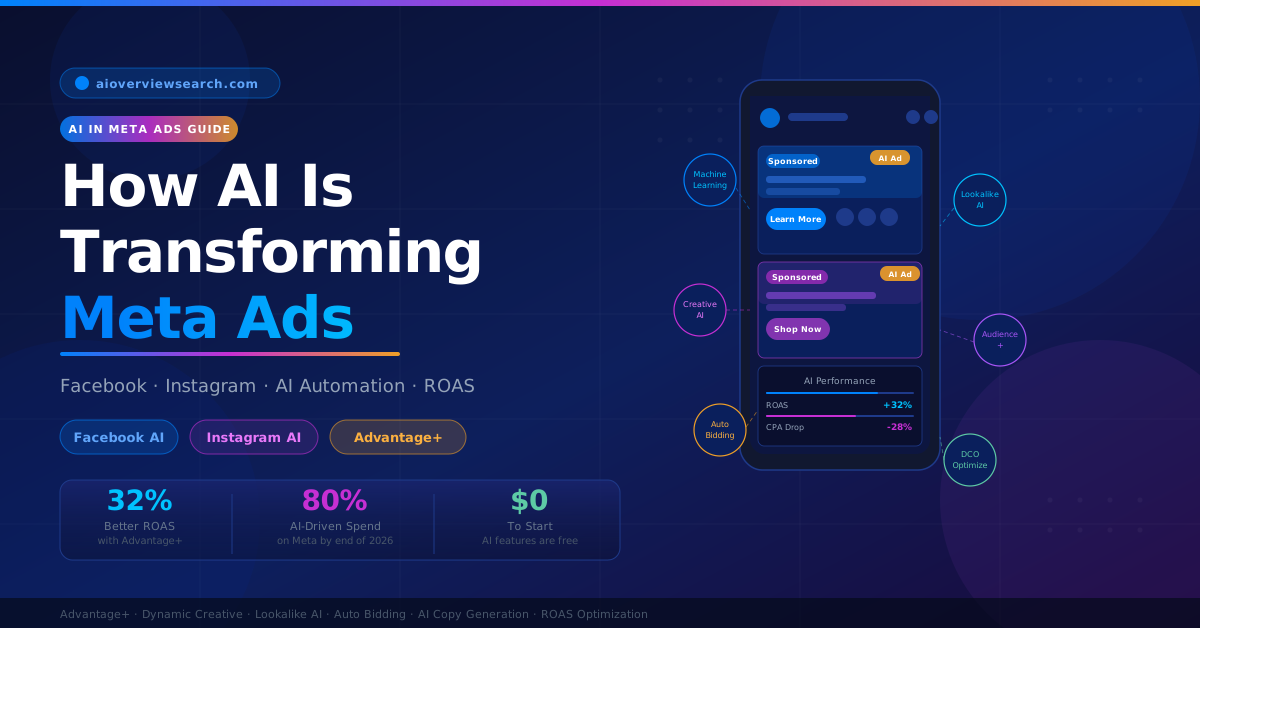
This guide breaks it all down simply, clearly, and practically. No jargon, no fluff. Just what you need to know to make AI work for your advertising goals.
Table of Contents
- What Is AI in Meta Ads?
- How Does AI Work Inside Meta’s Ad Platform?
- Key AI Features in Meta Ads (2026 Edition)
- Facebook AI Advertising: Real-World Use Cases
- Instagram AI Ads: What’s Different?
- Meta Ads Automation: Advantage+ Explained
- Benefits of AI Meta Ads
- Risks and Limitations You Should Know
- Myth vs. Reality: AI in Meta Advertising
- Step-by-Step: How to Use AI Meta Ads Features
- AI Meta Ads vs. Traditional Manual Campaigns
- Expert Insights and Predictions
- Future Trends in AI Meta Advertising
- FAQs
- Conclusion + CTA
What Is AI in Meta Ads?
At its core, AI in Meta Ads refers to the use of machine learning algorithms, predictive analytics, and generative AI to automate, optimize, and personalize advertising across Facebook and Instagram.
Meta (formerly Facebook) has been building AI into its ad platform since the early 2010s. But what’s happened in the last two to three years is a quantum leap AI has moved from being a background optimization tool to the primary decision-maker in how ads are created, targeted, delivered, and optimized.
Quick Definition (Featured Snippet Optimized):
AI in Meta Ads is the application of artificial intelligence technologies – including machine learning, natural language processing, and generative AI – within Meta’s advertising ecosystem to automate campaign creation, optimize ad delivery, personalize creative content, and improve return on ad spend (ROAS) without constant human intervention.
In plain English: Meta’s AI figures out who should see your ad, when they should see it, what version of your ad they should see, and how much to bid – all automatically, all in real time.
How Does AI Work Inside Meta’s Ad Platform?
Understanding the mechanics helps you use the platform more effectively. Here’s how Meta’s AI actually operates under the hood:
The Auction System
Every time a Facebook or Instagram user scrolls past an ad slot, an AI-powered auction happens in milliseconds. Meta’s algorithm evaluates:
- Bid amount – how much advertisers are willing to pay
- Estimated action rates – how likely is this specific user to click, buy, or convert?
- Ad quality and relevance – does this ad match what this user actually cares about?
The winner isn’t just the highest bidder. It’s the ad with the best combination of all three factors. This is AI making real-time economic decisions at billions of transactions per day.
Machine Learning Models
Meta uses multiple ML models simultaneously:
- Lookalike modeling – finds users who behave similarly to your existing customers
- Conversion prediction models – estimates who is most likely to complete a desired action
- Creative fatigue detection – identifies when an audience is getting tired of seeing the same ad
- Budget allocation models – decides where within a campaign to spend money for maximum results
Generative AI Layer
Since 2023, Meta has added a generative AI layer that can:
- Write ad copy variations
- Generate background images for product photos
- Expand images to fit different ad formats (Reels, Stories, Feed)
- Create multiple creative variations from a single asset
This is where the platform has taken a genuinely new direction – AI isn’t just optimizing your ads anymore, it’s creating them.
Key AI Features in Meta Ads (2026 Edition)
1. Advantage+ Shopping Campaigns (ASC)
Meta’s most powerful fully automated campaign type. You upload your products and creative assets – AI handles everything else: audience targeting, placement, bidding, and creative combinations.
Best for: E-commerce brands with a product catalog
2. Advantage+ Audience
Replaces manual audience targeting. Instead of building detailed demographic or interest-based audiences yourself, you give Meta’s AI a starting signal (like a custom audience) and it expands from there, finding people most likely to convert.
3. Advantage + Creative
Automatically applies enhancements to your ad creative:
- Adjusts brightness and contrast
- Adds music to video ads
- Applies text variations
- Crops images for different placements
4. AI-Generated Ad Copy
Meta’s generative AI tools (within Ads Manager) can now suggest and write primary text, headlines, and descriptions based on your landing page URL or product description.
5. Dynamic Creative Optimization (DCO)
Upload multiple headlines, images, descriptions, and CTAs. Meta’s AI mixes and matches them in real time to find the highest-performing combination for each individual user.
6. Automated Budget Optimization (CBO/ABO AI)
Meta’s AI dynamically shifts budget across ad sets in real time, channeling more spend toward what’s working and pulling back from underperforming segments – without you touching anything.
7. AI-Powered Reporting and Insights
Meta’s AI now surfaces actionable insights automatically – “Your video ads are outperforming image ads by 34% with 25-34 year olds” – without you having to dig through dashboards.
Facebook AI Advertising: Real-World Use Cases
Case Study 1: Small E-Commerce Brand
A clothing boutique in Austin, Texas with a $500/month ad budget switched from manual Facebook campaigns to Advantage+ Shopping. Within 60 days:
- Cost per purchase dropped by 28%
- Return on ad spend increased from 1.8x to 3.1x
- Time spent managing campaigns dropped from 8 hours/week to 90 minutes/week
The AI found customer segments the owner had never thought to target – specifically, men buying gifts, a demographic she had ignored entirely.
Case Study 2: Local Service Business
A dental practice in Chicago used Facebook AI advertising with Advantage+ Audience to promote teeth whitening services. Instead of manually targeting “people interested in dentistry,” the AI found a high-converting segment: users who had recently searched for wedding venues, engagement ring content, and event planning services – people preparing for big life moments who wanted to look their best.
That’s the kind of lateral thinking that AI does extremely well and humans rarely think to do.
Case Study 3: SaaS Company
A B2B software startup used Dynamic Creative Optimization to test 6 headlines, 4 images, and 3 CTAs simultaneously. The AI ran 72 possible combinations and identified the top 3 within 7 days – without blowing the budget on underperforming variants.
Instagram AI Ads: What’s Different?
Instagram and Facebook share the same underlying AI infrastructure, but Instagram’s ad environment has some distinct characteristics that Meta’s AI accounts for:
Visual-First Optimization
Instagram’s AI places heavier weight on visual quality signals – thumb-stop rate, video completion rate, and save rate – compared to Facebook where text engagement plays a larger role.
Reels Placement AI
Meta’s AI has developed specific models for Instagram Reels ads that factor in content context. Your ad is more likely to be shown after content that thematically aligns with your product.
Shopping Integration
Instagram’s AI connects product catalog ads with users’ shopping behavior signals across the app – saves, product page visits, wishlist additions – creating a hyper-targeted retail experience.
Creator Content Signals
Instagram AI ads can now leverage performance data from branded content (influencer posts) to inform how paid ads are targeted and optimized.
Meta Ads Automation: Advantage+ Explained
Advantage+ is Meta’s umbrella brand for all its AI-powered automation tools. Think of it as the “autopilot mode” for your ad campaigns.
Here’s a simple breakdown:
| Feature | What It Automates | Manual Alternative |
| Advantage+ Audience | Targeting | Custom/Saved Audiences |
| Advantage+ Placements | Where ads show | Manual placement selection |
| Advantage+ Creative | Ad design variations | A/B testing manually |
| Advantage+ Shopping | Full campaign management | Manual shopping campaigns |
| Advantage+ Budget | Spend allocation | Manual CBO/ABO settings |
The key insight: Advantage+ works best when you give it enough data. Meta recommends a minimum of 50 conversions per week for the AI to optimize effectively. Below that threshold, results can be inconsistent.
Benefits of AI Meta Ads
For Business Owners and Marketers:
- Saves time – campaigns that used to take days to set up can be launched in hours
- Improves performance – AI optimization typically outperforms manual targeting over time
- Scales efficiently – AI can manage complexity that would overwhelm a human team
- Lowers cost per result – better targeting = less wasted spend
- Democratizes advertising – small businesses get access to enterprise-level optimization
For Users (Indirectly):
- Sees more relevant ads (better experience)
- Less ad fatigue from irrelevant content
Measurable Impact:
According to Meta’s own data, advertisers using Advantage+ Shopping Campaigns see an average of 32% improvement in cost per acquisition compared to standard shopping campaigns. Independent analyses from agencies like Tinuiti have confirmed results in the 20 to 40% improvement range.
Risks and Limitations You Should Know
AI in Meta Ads isn’t magic. Here’s what can go wrong:
1. Black Box Problem
Meta’s AI doesn’t fully explain why it makes specific decisions. You can see results, but not always the reasoning – which makes troubleshooting difficult.
2. Learning Phase Instability
When a campaign enters the “learning phase” (AI gathering data to optimize), performance can be erratic. Inexperienced advertisers often panic and make changes during this phase, resetting the learning and making things worse.
3. Creative Dependency
AI can optimize delivery, but it can’t fix bad creative. If your ad imagery, copy, or offer isn’t compelling, no amount of AI targeting will save it. Garbage in, garbage out.
4. Data Privacy Constraints
iOS 14+ privacy changes, cookie deprecation, and evolving regulations have reduced the data signal available to Meta’s AI. This affects targeting accuracy, particularly for smaller advertisers who rely on pixel data.
5. Budget Minimums
AI-powered campaigns like Advantage+ Shopping perform best with meaningful budgets. Advertisers spending less than $30–50/day may not see the full benefit of AI optimization.
6. Over-Automation Risk
Fully automated campaigns can occasionally serve ads in brand-unsafe contexts or to audiences that don’t align with your brand values. Regular monitoring is still essential.
Myth vs. Reality: AI in Meta Advertising
| Myth | Reality |
| “AI will replace media buyers and ad managers” | AI handles optimization; humans still lead strategy, creative direction, and brand decisions |
| “Advantage+ always outperforms manual campaigns” | Advantage+ typically wins in e-commerce; manual still has advantages in niche B2B targeting |
| “You don’t need to monitor AI campaigns” | AI campaigns still require regular creative refreshes, budget management, and performance review |
| “AI targeting means zero privacy violations” | Meta’s AI works within privacy frameworks but data usage remains a complex ethical area |
| “More automation = better results always” | Over-automating without sufficient data or budget leads to poor AI decisions |
| “AI ads are too expensive for small businesses” | Many AI features are free within Meta Ads Manager; the cost is your ad spend |
Step-by-Step: How to Use AI Meta Ads Features
Step 1: Set Up Your Meta Business Account
Ensure your Meta Business Suite, Ads Manager, and Pixel are properly configured. Without pixel data, AI features are significantly limited.
Step 2: Define Your Campaign Objective Correctly
Choose the objective that matches your actual business goal (Sales, Leads, Traffic). Meta’s AI optimizes toward the objective you select – choose wrong and it optimizes toward the wrong outcome.
Step 3: Enable Advantage+ Options
When setting up your campaign, toggle on:
- Advantage+ Audience (instead of manual targeting)
- Advantage+ Placements (instead of manual placement selection)
- Advantage+ Creative (in the ad creation step)
Step 4: Upload Multiple Creative Assets
Give the AI fuel to work with. Upload at minimum:
- 3–5 image variations
- 1–2 video clips
- 3 headline variations
- 2–3 primary text variations
Step 5: Set Your Budget and Let It Run
For best results, commit to running the campaign for at least 7 days without major changes. The learning phase requires stability.
Step 6: Review AI Insights Weekly
Check the “Breakdown” and “Insights” tabs in Ads Manager. Meta’s AI surfaces performance patterns – use these to inform your next creative refresh.
Step 7: Refresh Creative Every 3-4 Weeks
AI handles targeting, but creative fatigue is real. New images, videos, and copy variations keep your campaigns performing at peak levels.
AI Meta Ads vs. Traditional Manual Campaigns
| Factor | AI Meta Ads (Advantage+) | Traditional Manual Campaigns |
| Setup Time | Fast (hours) | Slower (days) |
| Targeting Precision | AI-driven, broad-to-precise | Human-defined, specific |
| Creative Testing | Automatic (DCO) | Manual A/B testing |
| Budget Management | Automatic reallocation | Manual adjustment |
| Best For | E-commerce, app installs, lead gen at scale | Niche B2B, tight audience targeting, brand awareness |
| Transparency | Lower (black box) | Higher (you control decisions) |
| Performance Over Time | Improves as AI learns | Requires active management |
| Minimum Budget | $30–50+/day recommended | Can work at lower budgets |
| Required Expertise | Lower (AI handles complexity) | Higher (needs experienced media buyer) |
Verdict: For most small to mid-size businesses, AI-first campaigns are the smart default. Manual campaigns remain valuable for brands with specific targeting needs or strict brand safety requirements.
Expert Insights and Predictions
Andrew Tindall, SVP Global Partnerships at System1, has noted that the brands winning with AI ads aren’t those who automate everything – they’re those who combine AI efficiency with emotionally resonant human creative.
Meta’s own research team has published findings showing that AI-optimized campaigns improve median ROAS by 22% in the first 90 days compared to unoptimized equivalents.
Mark Zuckerberg outlined in Meta’s 2024 earnings call that the company is investing billions in AI infrastructure specifically to improve ad performance – because ad revenue is directly tied to how well AI can match ads to users.
Industry analysts at eMarketer project that AI-driven ad spend on Meta platforms will account for over 80% of all Meta advertising activity by end of 2026, up from approximately 60% in early 2024.
The direction is clear: this isn’t a trend. It’s the permanent new architecture of digital advertising.
Future Trends in AI Meta Advertising
1. Fully Generative Ad Creation
By late 2026, Meta is expected to roll out tools where an advertiser inputs a URL and a goal – and AI generates the entire campaign including copy, creative, audience, bid strategy, and placement – end to end.
2. AI Video Ad Production
Generative AI video tools integrated into Ads Manager will allow businesses to produce Reels-ready video ads without any production resources. Early versions already exist; production-quality versions are imminent.
3. Real-Time Personalization at Scale
Rather than showing the same ad to everyone in an audience, Meta’s AI will serve a uniquely personalized version of the ad to each individual user – different background, different headline, different offer emphasis – all generated dynamically.
4. Predictive Budget Planning
AI tools will be able to tell you, before you spend a dollar, what your likely ROAS will be based on your creative, audience, and historical category data – enabling smarter budget planning.
5. Cross-Platform AI Optimization
Meta’s AI will increasingly optimize across Facebook, Instagram, Messenger, WhatsApp, and the Audience Network simultaneously, treating the entire Meta ecosystem as one unified canvas.
6. Privacy-Preserving AI
As third-party data continues to decline, Meta is investing heavily in on-device AI and privacy-safe machine learning approaches (like federated learning) that can optimize ads without accessing raw user data.
5. FAQs
Q1: What is AI in Meta Ads?
A: AI in Meta Ads refers to the use of machine learning and generative AI technologies within Meta’s advertising platform (Facebook and Instagram) to automate targeting, optimize ad delivery, generate creative content, and improve campaign performance – all without constant manual input.
Q2: How does Facebook AI advertising work?
A: Facebook’s AI advertising works through a real-time auction system powered by machine learning. When an ad slot becomes available, Meta’s AI evaluates thousands of signals about the user (interests, behaviors, past actions) and all competing ads, then selects the most relevant ad to show in milliseconds.
Q3: Is Meta Ads automation better than manual campaigns?
A: For most advertisers – especially in e-commerce – Meta’s AI automation (Advantage+) tends to outperform manual campaigns over time because AI can process far more data signals than any human can. However, manual campaigns still have advantages for niche targeting and brand safety control.
Q4: What is Advantage + in Meta Ads?
A: Advantage+ is Meta’s suite of AI-powered automation tools. It includes Advantage+ Audience (automated targeting), Advantage+ Placements (automated placement selection), Advantage+ Creative (automated creative enhancements), and Advantage+ Shopping Campaigns (fully automated e-commerce campaigns).
Q5: Does Meta use AI to create ads automatically?
A: Yes. Meta’s generative AI tools within Ads Manager can now write ad copy, generate image variations, expand images for different formats, and suggest creative enhancements automatically – though human review is still recommended before publishing.
Q6: How does Instagram AI ads targeting work?
A: Instagram AI ad targeting uses behavioral signals from within the app – video watches, saves, product views, profile visits, and engagement patterns – combined with data from Facebook and Meta’s broader network to identify which users are most likely to take the action your campaign is optimized for.
Q7: What budget do I need for AI Meta Ads to work effectively?
A: Meta’s AI needs sufficient data to optimize. A general rule of thumb is $30 to 50/day minimum for AI campaigns to exit the learning phase properly. For Advantage+ Shopping campaigns, budgets of $50 to 100/day tend to produce more consistent AI optimization results.
Q8: Can small businesses benefit from AI in Meta Ads?
A: Absolutely. AI-powered features in Meta Ads are available to all advertisers regardless of budget size. Small businesses benefit because AI levels the playing field – a $500/month advertiser can access the same optimization technology as a $500,000/month advertiser.
Q9: What are the risks of using AI in Facebook advertising?
A: Key risks include: reduced transparency (AI doesn’t always explain its decisions), learning phase instability, creative dependency (AI can’t fix a bad offer or unappealing creative), potential for ads to appear in unintended contexts, and reduced effectiveness at very low budgets.
Q10: What is the future of AI in Meta advertising?
A: The future includes fully generative ad creation (AI builds entire campaigns from a URL), real-time personalized ad variations for each individual user, predictive ROAS forecasting, AI video production tools, and privacy-preserving optimization that works without third-party data.
Conclusion + CTA
AI in Meta Ads isn’t a feature you opt into – it’s increasingly the foundation on which the entire platform runs. Understanding how it works doesn’t just make you a better advertiser. It makes you a smarter decision-maker in a world where AI is touching every corner of marketing, business, and technology.
The advertisers who will win the next five years aren’t necessarily those with the biggest budgets. They’re the ones who understand how to collaborate with AI – giving it the right inputs (clear objectives, strong creative, meaningful budgets) and knowing when to override it with human judgment.
You now have a clearer picture than most.
What’s your next move?
- Subscribe to AI Overview Search for weekly breakdowns of AI tools, trends, and strategies – explained simply.
- Drop a comment below Are you using AI features in your Meta Ads? What’s working? What isn’t?
- Share this article with a marketer or business owner who’s still running 100% manual campaigns.
🔗 Explore more on aioverviewsearch.com – We cover the AI tools and trends that actually matter for your work and business.