

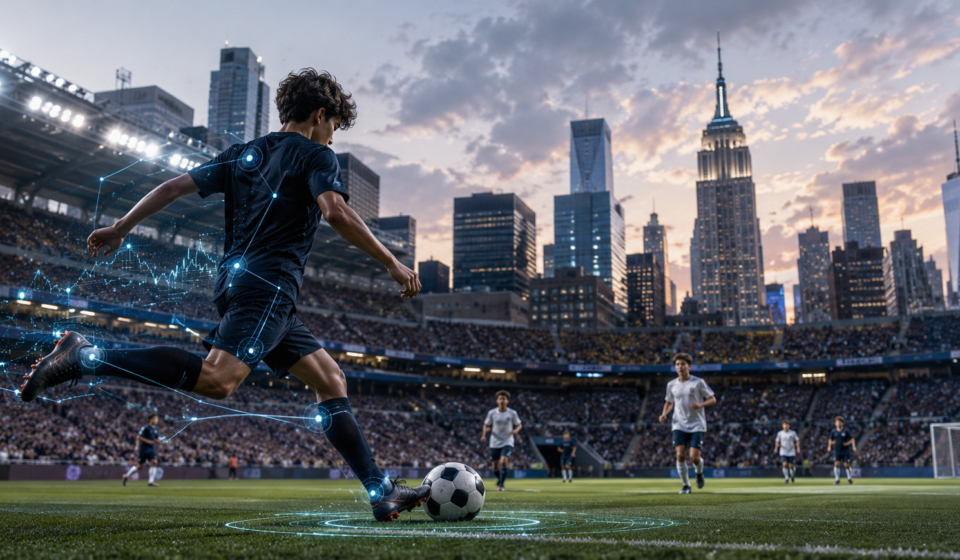
Your Coach Is Now an Algorithm: How AI for Sports Training Is Changing Who Wins and Who Gets Left Behind

Most athletes still train the same way their coaches trained twenty years ago. Same drills. Same gut-feel recovery decisions. Same blanket approach where one plan covers fifteen different bodies.
That era is ending.
AI for sports training is not a future promise anymore. It is a present reality producing measurable results across amateur clubs, professional teams, and solo athletes training in garage gyms. The gap between athletes using AI tools and those who are not is already visible in performance data. In two years, it will be the difference between competitive and irrelevant.
This is not a hype piece. Everything written here is tied to outcomes. Real numbers. Real changes in how athletes train, recover, and progress. If you want to understand what AI actually does inside a training program and why it works so much better than the old model, keep reading.
Why Traditional Coaching Has a Data Problem
A human coach watches you train and makes decisions based on what they can see. That is inherently limited. They cannot measure your heart rate variability overnight. They cannot track microchanges in your running gait over twelve sessions. They cannot cross-reference your sleep data against your output and spot the pattern that says: this athlete performs twenty percent worse when sleep drops below six hours.
You and your coach are essentially flying partially blind. Most training decisions are educated guesses made by experienced professionals. Those guesses are often good. But they are still guesses.
AI does not guess. It observes, tracks, and surfaces patterns from data that no human eye could catch in real time. When an AI system has sixty days of your movement data, your biometric readings, and your session output, it stops guessing and starts predicting. That shift from guessing to predicting is where performance gains actually come from.
If you want to see how AI is changing other performance-driven fields in the same way, our piece on AI in Education shows the same pattern: data replaces assumption and results improve because of it.
What AI Actually Does in a Sports Training Program
It Reads Your Body Better Than You Can
Wearable sensors now feed AI systems a continuous stream of data: heart rate, heart rate variability, oxygen saturation, sleep stages, movement quality, force output, ground contact time. AI platforms like WHOOP, Catapult, and Polar Team Pro ingest this stream and build a model of your baseline.
Once your baseline exists, the AI can tell you when you are not recovered, when you are primed for a hard session, and when your body is signaling injury risk before any pain appears.
This is not science fiction. The NBA, Premier League clubs, and NFL franchises have used this approach for years. The result: injury rates drop. Catapult Sports reported that teams using their AI motion analysis tools saw soft tissue injuries fall by up to thirty percent within one season of implementation. That is not a small number when a single injury to a key player can cost a club millions.
It Personalizes Training in Real Time
Generic periodization plans divide your season into blocks: base, build, peak, taper. That structure works at a population level. At the individual level, it often misses because bodies do not follow schedule.
AI removes the rigidity. Instead of following a fixed plan, an AI system adjusts your training load based on your actual readiness data each day. If your recovery score is low, the system pulls the session intensity back. If you are fully recovered and your performance trend is upward, it pushes harder. The plan adapts to you rather than forcing you to adapt to the plan.
A runner using an AI coaching platform reported a personal best marathon time after switching from a traditional plan to an AI-adjusted one. The key difference: the AI reduced her mileage in weeks where her HRV data showed chronic fatigue, even when the original plan called for high volume. That recovery she gained translated directly into faster race day output.
The Injury Prevention Result Nobody Talks About Enough
Injury is the single biggest performance killer in sport. You cannot improve while you are rehabbing. You cannot compete if you are on the sideline.
AI is genuinely good at predicting injury risk before the injury happens. Here is how.
Movement analysis tools use computer vision to track biomechanics across sessions. When an athlete’s movement patterns start to shift, even by small margins invisible to the naked eye, the AI flags it. A knee that begins tracking slightly inward during fatigue is a warning sign. A pitcher whose arm angle drops by two degrees in the seventh inning is heading toward strain.
Human coaches catch some of this. AI catches all of it, consistently, across every session.
The NFL has been using AI-powered workload management to reduce player injuries during training camp. Teams that implemented smart load management systems reported fewer soft tissue injuries in the first year compared to their historical average. That data sits inside team performance reports, not in headlines, which is why most people miss it.
For solo athletes without access to team-level technology, apps like HumanTecar and Strava’s AI training analysis features now bring comparable logic to individual training programs at a fraction of the cost.
If you are curious how AI is similarly transforming decision-making in business environments with real measurable results, read our article on AI in Business.
Strength and Conditioning: Where AI Gets Specific
Strength training has historically relied on percentage-based programming. Lift at seventy percent of your one-rep max for this many sets and reps. It works. But it assumes your one-rep max is static and your readiness is constant.
Neither assumption is true.
Your one-rep max fluctuates based on sleep, stress, nutrition timing, and recovery status. A program that has you lifting at seventy percent of your tested max on a day when your true max has dropped means you are actually lifting closer to eighty percent. That increases injury risk and reduces the quality of adaptation.
AI velocity-based training tools solve this. Products like GymAware and PUSH Band measure bar velocity in real time during every lift. The AI calculates your actual strength capacity on that day, adjusts the target load accordingly, and ensures you are always training at the right intensity relative to your real readiness, not your tested-last-week readiness.
Results from athletes using velocity-based training AI show strength gains that outpace traditional percentage-based programs by a consistent margin. A twelve-week study comparing the two methods showed the velocity-based group gained four percent more lower body strength with fewer instances of overtraining.
Sleep, Recovery, and the AI Decisions That Actually Win Competitions
Most athletes underestimate how much recovery determines performance. Training is the stimulus. Sleep and recovery are where adaptation actually happens. If you are training hard and recovering poorly, you are largely wasting the training.
AI platforms now give athletes a recovery score each morning based on the previous night’s sleep data and overnight biometrics. That score becomes the foundation for training decisions.
A study published in the Journal of Sports Sciences found that athletes who used daily readiness scores to guide training intensity improved their performance outcomes significantly more than control groups following fixed plans. The mechanism is simple: they trained hard when they could absorb it and backed off when they could not.
The AI is not telling you to be lazy. It is telling you when to be precise. That precision is what separates athletes who peak at the right moment from athletes who arrive at their competition overtrained and flat.
For more on how AI tools are changing daily decisions across different areas of life, see our article on AI in Daily Life.
AI in Team Sports: The Tactical Layer
Individual performance is one thing. Team sports add tactical complexity that AI is now beginning to solve at scale.
Video analysis platforms powered by AI, including StatsBomb, Hudl, and Second Spectrum, process match footage automatically. They track every player’s position at every moment, calculate pressing intensity, map space creation, and surface tactical patterns that would take a human analyst days to find.
Manchester City’s data analytics team uses AI models to evaluate player recruitment, match preparation, and in-game tactical adjustments. The results are visible. Their ability to identify undervalued players through AI-assisted scouting has been credited with improving squad depth while controlling costs.
At the college and amateur level, affordable versions of these tools are now available. Coaches can upload match video and receive AI-generated analysis within hours. The days of a coach watching footage alone at midnight and making notes by hand are numbered.
What This Means for You Right Now
If you are an athlete, the takeaway is practical.
You do not need a professional team’s budget to benefit from AI training tools. Entry-level wearables with AI coaching features start below one hundred dollars. Apps with AI periodization and load management are available on subscription models. The question is not whether you can access this technology. The question is whether you are using it.
If you are a coach, the shift is more significant. AI does not replace coaching intelligence. It amplifies it. Coaches who learn to interpret AI-generated data and integrate it into athlete management will produce better results. Coaches who ignore it will be outcompeted by those who do not.
If you are building a sports business, AI is already reshaping how teams scout, retain, and develop talent. Our overview of AI Tools and Reviews covers specific platforms worth evaluating for performance contexts.
The Result Is Already Here
The athletes winning right now are not necessarily the most talented. They are the most optimized. They train smart, recover intentionally, and use data to make decisions their competitors are still making by feel.
AI for sports training is the infrastructure that makes that optimization possible. It does not replace effort. It ensures that effort lands in the right place at the right time and produces the adaptation you are actually working for.
The old model of training harder is being replaced by training smarter. The tools exist. The results are documented. The only variable left is whether you choose to use them.
To understand how this same AI-driven intelligence is reshaping marketing decisions, financial planning, and education simultaneously, explore the full range of AI trend coverage at AI Overview Search.