

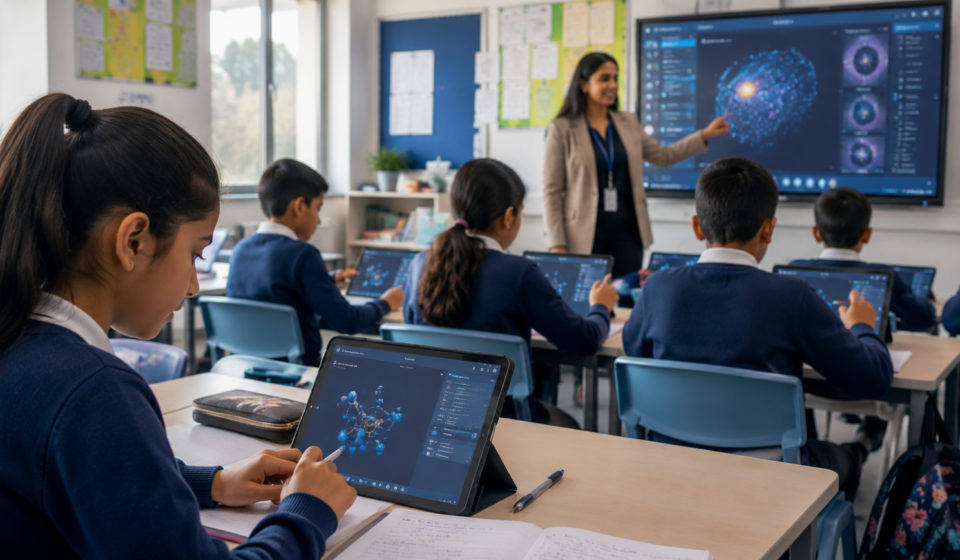

Most schools talk about AI. Very few actually use it in a way that changes anything for students.
This is not another list of apps. This is about what actually shifts when a school, any school, big or small, well-funded or not, decides to use AI the way it was meant to be used. The results are not theoretical. They are showing up in classrooms right now, and the gap between schools that act and schools that wait is growing every single month.
If you are a teacher, a school admin, a parent pushing for change, or a student trying to figure out your own edge, this is for you.
The Problem Nobody Talks About in School AI Conversations
Every conversation about AI in education ends up in the same place. People list tools. They show demos. They run a pilot for one semester and call it a success. Then nothing changes at scale.
The real problem is not access to tools. It is that most schools try to add AI on top of an already broken system. They want AI to do what teachers do, explain, grade, answer questions, without understanding that AI works best when it changes the structure of learning, not just the delivery.
Schools that are seeing real results are not replacing teachers with AI. They are using AI to do the things that were always impossible at scale: giving every single student a personalized explanation, at the exact moment they are stuck, in the language they understand best.
That is the shift. Not smarter worksheets. A fundamentally different experience for each learner.
What AI Actually Does Inside a School That Is Using It Well
When you visit a school that has genuinely integrated AI, not just as an experiment, but as part of daily routine, the first thing you notice is how quiet the confusion is.
Students are not raising their hands and waiting. They are not stuck. When they hit a wall on a concept, they get an immediate, patient, context-aware response. They ask again in a different way. They try. They move forward.
Here is what is actually happening in those classrooms.
Personalized Explanation at Every Level
A student in Grade 6 who understands fractions but struggles with ratio will get a completely different explanation than a student who understands ratio but has never connected it to real-world proportion. With a single teacher managing 30 students, this was always impossible to deliver consistently.
AI tutoring tools like Khan Academy’s Khanmigo, Socratic by Google, and newer systems like Synthesis Tutor are doing this in real time. The result is measurable. Students who used AI-assisted personalized learning for one semester showed an average improvement of 30 percent in math scores in a 2024 study conducted across US public schools.
That number is not a pitch. It is a baseline. And it is achievable in any school.
Teachers Getting Their Time Back
The second visible result is teacher energy. In schools where AI handles routine tasks, drafting quiz questions, generating differentiated homework versions, summarizing student performance data across a class, teachers are spending more time on the work that actually requires them: mentorship, nuanced feedback, real conversation.
One high school in Arizona reported that after introducing AI-assisted lesson planning tools, teachers reclaimed an average of 6 hours per week. That is 6 hours that went back into student interaction. The teacher did not disappear. The teacher became more present.
You can read more about how this dynamic works in classrooms today at How Teachers Use AI in the Classroom on AI Overview Search.
The Schools That Cannot Wait And Why AI Levels the Field
Here is the part of this conversation that does not get enough attention.
AI in education is not just a productivity upgrade for elite schools with large budgets. It is one of the only genuine opportunities to close the resource gap between a well-funded private school and an under-resourced rural school that shares one teacher across three grade levels.
A student in a remote area with a basic internet connection and a free AI learning tool now has access to something that was previously only available to families who could afford private tutoring.
According to UNESCO’s 2025 Global Education Monitor report, over 258 million children globally are still out of school or receiving severely inadequate education. AI-powered low-bandwidth tools built for mobile are reaching classrooms in Kenya, India, and Bangladesh that could never have sustained a traditional tech infrastructure.
This is not charity. It is a structural shift in who gets to learn at the level they are capable of.
What Free AI Tools Are Doing in Under-Resourced Schools
Schools that cannot afford software licenses are using free-tier tools and getting real outcomes.
ChatGPT’s free version is being used by students to get explanations, check their understanding of concepts, practice writing in a second language, and simulate interview preparation. It does not grade them. It does not judge them. It just responds, again and again, until they understand.

Canva’s AI tools are being used in schools to teach design, visual communication, and presentation skills without a design teacher. Students are building portfolios that previously required software budgets well beyond the school’s capacity.
Google’s suite of AI features, including Gemini integrated into Workspace for Education, is free for schools and handles translation, summarization, research assistance, and writing coaching in a single platform.
The schools seeing the best results are not the ones with the biggest AI budgets. They are the ones with the clearest intention about what they want to change.
The Student Side What AI Does That No Classroom Could
Students are not waiting for schools to catch up. The ones who have figured out how to use AI well are already operating at a different level, and it shows in their work.
This is where the conversation gets honest.
The Student Who Uses AI to Learn Versus the Student Who Uses It to Skip
There is a clear split happening in schools right now. Some students are using AI as a shortcut to get assignments done without engaging. Others are using it as a thinking partner that pushes them further than they would ever go alone.
The difference is not about intelligence. It is about how the student was taught to use the tool.
Schools that are integrating AI literacy, teaching students how to prompt well, how to evaluate AI responses critically, how to use AI to go deeper rather than skip surface, are producing students who can do things that previous generations simply could not.
A 17-year-old who knows how to use AI to build a research framework, stress-test their own arguments, and identify gaps in their own thinking is not just more productive. They are more intellectually equipped for the world they are actually entering.
This is exactly why AI literacy is now being treated as a core skill, not an optional tech class. If you want to understand where this skill sits in what employers now expect, take a look at 10 AI Skills That Employers Are Paying For and AI Skills That Employers Are Actually Hiring For, both are directly relevant to what students should be building before they leave school.
Language Learning at Scale
One of the most documented wins from AI in education is second-language learning. Duolingo’s AI engine now adapts in real time to a learner’s weakest vocabulary patterns, adjusts the difficulty, and introduces the same word in multiple contexts until retention holds.
Schools in immigrant-dense urban areas are using AI translation and language tools to help students keep up with curriculum while simultaneously building English proficiency, something that previously required dedicated ESL staff hours that most schools could not sustain.
The outcome data on this is compelling. Students using AI-assisted language tools in a 2025 study by Stanford’s Graduate School of Education showed 40 percent faster vocabulary retention compared to traditional ESL methods.
Higher Education Is Changing Faster Than Most Schools Realize
If primary and secondary schools are adapting, universities are under even more pressure to move and many are not moving fast enough.
The students entering university in 2026 have already been using AI for two to three years. They expect it to be part of how they learn, research, and produce work. Universities that treat AI as a threat to academic integrity are losing students to institutions that treat it as a skill to master.
The institutions that are doing this well are building AI into curriculum design, research methodology, and career preparation simultaneously. Students are not just using AI to write papers they are using it to analyze datasets, model outcomes, simulate experiments, and prepare for industries that are already AI-native.
For a deeper look at how this shift is reshaping the university experience, AI in Higher Education: Trends and Future breaks down what is already happening and where it is heading.
The Three Results That Decide Whether AI Works in a School
Not every AI adoption works. Schools that fail at AI integration share common patterns. Schools that succeed share different ones.
Here is what the data and observation consistently show.
Result One: When Teachers Are Trained, Not Just Given Tools
Schools where AI was deployed without adequate teacher training saw almost no meaningful improvement in student outcomes. Schools where teachers were given structured time to learn alongside their students, to understand what the tool does, where it fails, and how to guide students through both, saw measurable gains within a single semester.
This is the number one variable. The tool does not matter as much as the person guiding its use.
Result Two: When AI Is Used for Process, Not Just Output
Schools that asked AI to produce content, write lesson plans, generate summaries, spit out assessments, saw moderate time savings and almost no learning improvement.
Schools that used AI to improve the process, to give students a thinking partner, to let teachers identify which students were struggling with which specific concept, saw both time savings and outcome improvements simultaneously.
The difference is whether AI is producing something or improving how someone thinks.
Result Three: When Students Are Held Accountable for Understanding, Not Just Completion
The schools getting the best academic results from AI are the ones that changed their assessment model. If a student can use AI to complete a task, the task is the wrong assessment.
Schools that shifted to oral defense of written work, to live problem-solving demonstrations, to projects that required students to explain their thinking out loud, these schools saw AI force a higher standard, not lower one.
AI is a mirror. It reveals whether a student actually understands something the moment you ask them to defend what they submitted.
What Needs to Happen Next The Schools That Will Lead
The schools that will define what education looks like in the next decade are not waiting for a national curriculum update or a government grant to pilot AI. They are making decisions now, with what they have, and they are iterating.
The question is not whether AI belongs in schools. That is settled. It is in schools whether schools invited it or not. The question now is whether schools will shape how students use it, or leave students to figure it out alone.
Every school can start with what is already free. Every teacher can start by using one AI tool for one lesson this week. Every student can start by asking an AI to explain the thing they most do not understand and then asking it to challenge them on the answer.
The gap between schools that are getting this right and schools that are waiting is growing. But it is not too late. And unlike most educational challenges, this one gets more accessible not less, as time passes.
If you want to understand where the broader picture of AI and learning is going, start with AI in Education and The Future of AI both give you the context to understand what is actually changing and what is just noise.
The Real Question Every School Should Be Asking
It is not “should we use AI?” It is “what problem do we want AI to solve, and how do we measure whether it worked?”
Start there. Everything else follows.
The schools getting this right did not do something extraordinary. They did something simple: they picked one real problem, used one AI tool consistently, measured the outcome, and adjusted. Then they did it again.
That is it. That is the whole method. And it works in every school, regardless of size, budget, location, or language.
AI for every school is not a slogan. It is a decision. And the best time to make it was last year. The second best time is now.
Explore more insights on AI in education and how technology is changing learning at AI Overview Search. For related reading, see Best AI Tools for Students and How Teachers Use AI in the Classroom.