

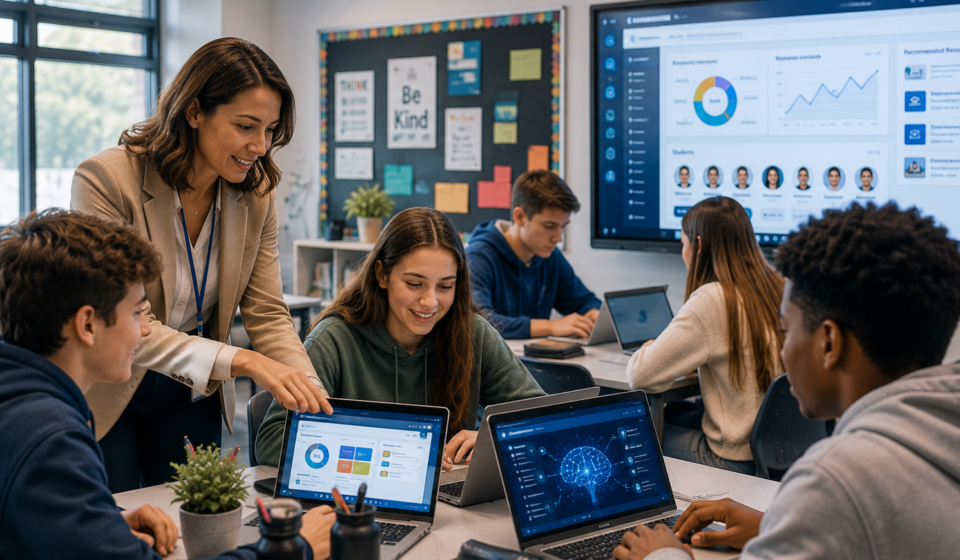

There is a moment every teacher knows well.
It is 11 PM. There are 34 ungraded essays on the desk, a lesson plan that still needs adjusting for tomorrow, and three students who needed extra support this week but did not get it because there was simply no time.
AI is not a magic fix for any of this. But right now, in schools across the country, teachers are quietly using it to reclaim some of that lost time – and what they are doing with it is worth paying attention to.
This is not a guide about robots replacing teachers. This is about what real classroom AI use actually looks like, from the inside.
The Shift That Is Already Happening
Most of the conversation around AI in Education has focused on students – whether they will cheat, whether it is fair, whether schools should ban it. That debate is happening in the wrong direction.
Teachers are the ones quietly transforming how they work.
A fifth-grade teacher in Ohio uses AI to generate three different versions of the same reading worksheet – one for on-level readers, one for students reading below grade level, and one for advanced learners. What used to take two hours now takes twelve minutes.
A high school history teacher in Texas uses it to build discussion prompts that connect current events to curriculum standards – something that used to require hours of research now gets a first draft in under five minutes.
These are not dramatic transformations. They are small, practical shifts that add up fast.
What Teachers Are Actually Using AI For
Here is a plain breakdown of where AI is showing up in real classrooms right now.
Lesson Planning
- Teachers feed AI their learning objectives and grade level, then ask for lesson ideas, activity formats, and discussion questions
- The AI does not write the lesson – the teacher does – but it gives a usable starting structure to work from
- This cuts planning time significantly, especially for new teachers or those covering unfamiliar topics
Differentiation
- Creating materials at multiple reading levels from a single source is one of the highest-value uses teachers have reported
- AI tools like ChatGPT or Claude can take one article, worksheet, or explanation and rewrite it for different ability levels on demand
- For teachers managing classrooms with wide ranges of student needs, this is genuinely useful
Feedback and Grading Support
- Some teachers use AI to generate first-pass feedback on written work – not to replace their judgment but to get a starting comment they can edit
- Others use it to check for common errors or gaps before returning work to students
- This is where teachers report the most time savings, but also where they are most thoughtful about using it carefully
Communication With Parents
- Writing parent emails, progress notes, and update letters takes up more teacher time than most people realize
- AI helps draft these quickly so teachers can spend more time personalizing them rather than writing from scratch
Assessment Creation
- Building quizzes, writing multiple choice questions, generating rubrics – these tasks are time-consuming and repetitive
- AI handles the first draft and teachers refine from there
The Part Nobody Talks About – The Learning Curve
Most articles about AI in education skip over this part.
Teachers are not AI experts. Many did not grow up with this technology. The learning curve is real, and the time pressure to figure it out while also running a full classroom is significant.
What separates teachers who find AI genuinely useful from those who try it once and give up comes down to one thing prompting.
AI tools return what you ask for. A vague prompt gives a vague result. A specific, detailed prompt gives something actually usable. Teachers who understand this get dramatically better results than those who do not.
If you are interested in how prompting actually works and how to get better results, the AI Tools & Reviews section on this site covers practical techniques that apply across education and beyond.
What the Research Is Starting to Show
Early data from classrooms using AI-assisted teaching tools is pointing in an interesting direction.
It is not that AI makes students smarter or that it replaces skilled teaching. The schools seeing the most positive results are those where teachers use AI to handle the repetitive, administrative side of the job – freeing up time and mental energy for the relational, human side that actually drives student outcomes.
Students learn better when teachers are less exhausted. That sounds obvious, but it has real implications.
If AI in Business is about efficiency and productivity, AI in education is about something slightly different – it is about giving teachers more capacity to actually teach.
The Tools Teachers Are Using Most
There is no single “best” AI tool for teachers. Different tools fit different needs. Here is a plain look at what is showing up in classrooms most frequently.
- ChatGPT – most commonly used for lesson drafts, differentiation, and writing support
- Claude – favored by many teachers for longer writing tasks and nuanced feedback generation
- Google Gemini – integrates naturally for teachers already working inside Google Classroom
- MagicSchool AI – built specifically for educators, with templates for lesson plans, parent communication, and IEPs
- Khanmigo by Khan Academy – student-facing AI tutoring that works alongside teacher instruction
Each of these has strengths and limitations. The AI Tools & Reviews category covers practical breakdowns of tools like these in more detail.
The Questions Teachers Are Still Wrestling With
Honest conversations about AI in classrooms do not skip the hard parts.
Academic integrity – If a teacher uses AI to write feedback, is that different from a student using AI to write an essay? This is a genuine tension that schools are navigating without a clean answer.
Equity – Not every school has reliable internet access, not every teacher has time to learn new tools, and not every district has resources for professional development. The schools that are benefiting most from AI are often already well-resourced. That gap matters.
Over-reliance – There is a real risk that teachers, especially new ones, lean too heavily on AI-generated materials and lose the creative and adaptive instincts that come from building lessons from scratch.
Student privacy – Many AI tools store or process the data fed into them. Using student work or identifying information in these systems raises legitimate questions that not enough schools are answering clearly yet.
None of these problems cancel out the usefulness of AI in classrooms. But pretending they do not exist does not help anyone.
A Note on What AI Cannot Do
This needs to be said plainly.
AI cannot notice that a student looks withdrawn today. It cannot build the kind of trust that makes a struggling teenager open up about what is going on at home. It cannot read a room, adjust tone in real time, or offer the kind of human connection that actually shapes how young people think about learning.
The most effective teachers using AI right now treat it as a tool for the logistics – and fiercely protect their time and attention for the human work.
That balance is not automatic. It takes intention.
What This Means Going Forward
AI is not going away from education, and neither is the need for great teachers. The next few years are going to involve a lot of schools, districts, and individual teachers figuring out in real time how to make these tools work without letting them flatten what makes good teaching good.
The teachers who are ahead of this curve right now are not the ones using AI the most. They are the ones using it most thoughtfully.
If you want to understand the broader picture of where AI is moving – not just in classrooms but across every sector – the Future of AI is worth reading. And if you are specifically interested in how AI is reshaping skills and careers in the current job market, 10 AI Skills That Employers Are Paying For gives a grounded look at what is actually in demand right now.
Conclusion
Teachers are using AI in real classrooms right now – not in some future version of education, but today. They are using it to save time on the work that drains them so they have more energy for the work that matters.
It is not perfect. It raises hard questions. But it is happening, and it is changing what the job looks like on a daily basis.
The conversation worth having is not whether AI belongs in classrooms. It is how to use it well.
Explore more at AI Overview Search – covering AI trends, tools, and real-world use across education, business, marketing, and beyond.