

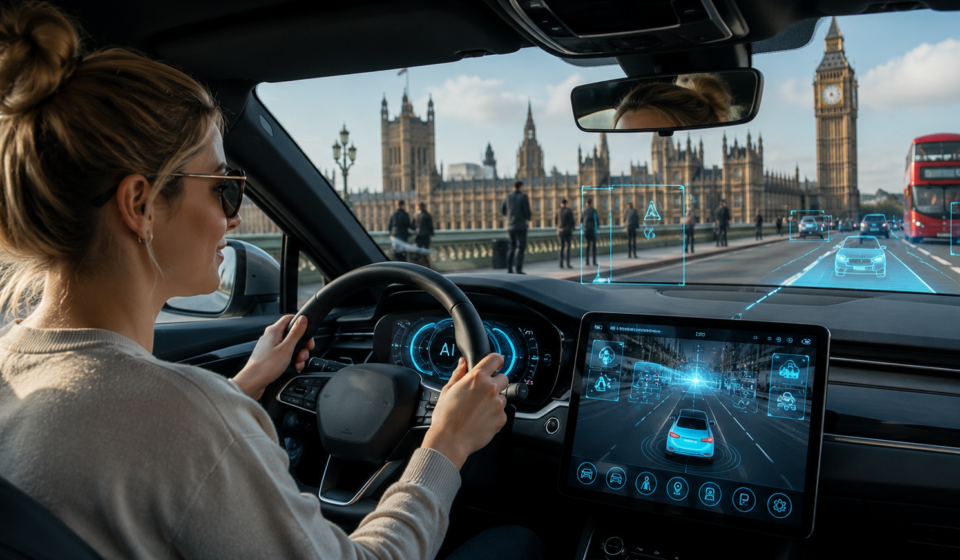
AI in Cars: How Artificial Intelligence Is Changing the Way Americans Drive

A few years ago, “smart car” mostly meant a vehicle with a touchscreen and Bluetooth. Today, that phrase means something completely different. Cars sold in the United States now come with cameras, sensors, and onboard computers that can see the road, read traffic signs, predict a collision before it happens, and even park themselves. This shift did not happen overnight, but it has happened faster than most drivers realized. AI in cars has quietly moved from a luxury feature to a standard expectation, and it is reshaping how people buy, drive, and think about their vehicles.
This blog breaks down what AI in cars actually means right now, where it is genuinely useful, where the hype outpaces reality, and what American drivers should know before their next purchase.
What “AI in Cars” Really Means
The term gets used loosely, so it helps to separate it into three categories.
The first is driver assistance. This includes lane-keeping alerts, adaptive cruise control, automatic emergency braking, and blind-spot monitoring. These systems use cameras and radar, combined with machine learning models, to detect what is happening around the car and react faster than a human driver could in some situations.
The second is in-cabin intelligence. This covers voice assistants, predictive navigation, personalized climate and seat settings, and driver monitoring systems that detect fatigue or distraction. These features do not drive the car, but they make the experience inside it smarter and, in many cases, safer.
The third is autonomous driving, which ranges from partial automation on highways to fully self-driving systems still being tested in limited markets. This is the category that gets the most attention, even though it represents the smallest slice of what is actually on American roads today.
Why This Matters for Everyday Drivers
Most people are not cross-shopping self-driving robotaxis. They are buying a car to commute, run errands, and drive their kids to school. For this group, AI matters less as a headline feature and more as a quiet layer of protection.
Automatic emergency braking alone has been shown to reduce rear-end collisions significantly. Lane departure warnings catch the moments when a driver’s attention drifts for a second too long. Adaptive headlights adjust in real time based on oncoming traffic. None of this is flashy, but it is the kind of technology that prevents accidents before they happen rather than reporting on them afterward.
This is also where AI is proving its worth outside the car itself. The same predictive thinking that helps a vehicle anticipate hazards is showing up in how people plan trips and manage logistics around driving. If you’re curious how AI is reshaping planning more broadly, our breakdown of AI in daily life covers how these small, practical tools are becoming part of ordinary routines rather than niche gadgets.
Self-Driving Cars: Where Things Actually Stand
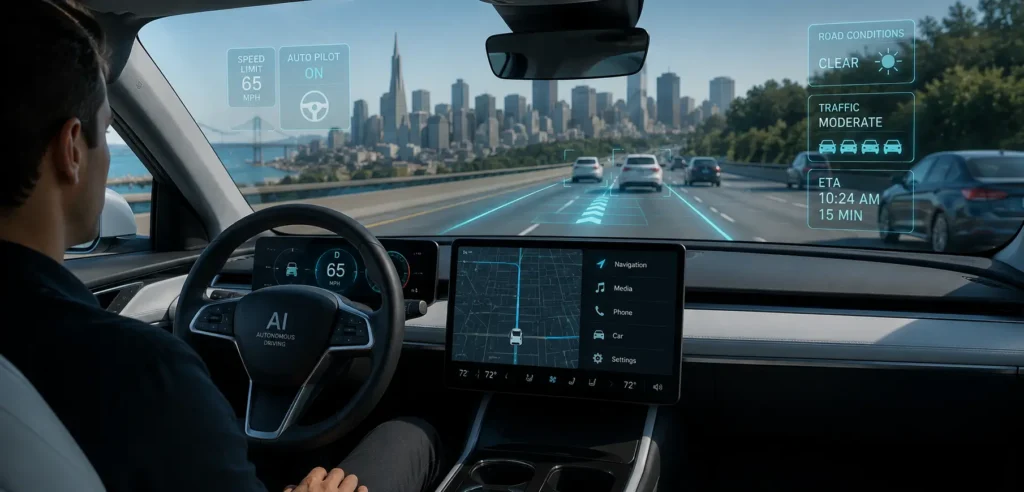
It is worth being direct here: fully autonomous cars, the kind with no steering wheel and no human oversight, are not something most Americans will be buying anytime soon. What exists today is a spectrum of automation levels, and the industry uses a five-level scale to describe it, ranging from basic driver assistance to full autonomy.
Most vehicles on the market sit at Level 2, meaning the car can control steering and speed under certain conditions, but the driver must stay alert and ready to take over. A small number of vehicles and pilot programs operate closer to Level 3 or Level 4 in specific, controlled environments.
The gap between what is technically possible in a lab and what is legally and practically deployed on public roads is significant. Regulation, liability, weather conditions, and unpredictable human drivers all slow down the rollout. This is not a criticism of the technology itself. It is simply a realistic picture of where things stand, which matters if you are trying to make a buying decision based on features rather than marketing language.
AI and Car Buying in the USA
AI is not just changing what happens inside the car. It is changing how people shop for one. Dealerships and manufacturers now use AI-powered tools to recommend trims, predict maintenance needs, and personalize pricing offers based on browsing behavior. Some buyers appreciate the convenience. Others find it invasive. Either way, it is now part of the process.
If you are evaluating any AI-powered tool, whether it is for buying a car, planning a trip, or managing your budget, the same basic questions apply: does it save real time, does it make decisions more transparent, and does it work reliably without constant correction. Our guide to AI tools and honest reviews applies that same lens across categories, which is useful context before trusting any AI-driven recommendation, automotive or otherwise.
Supercars, Performance, and AI
High-performance and luxury vehicles have become an unexpected proving ground for automotive AI. Performance brands use AI-adjusted suspension systems that read road conditions in real time and adjust stiffness within milliseconds. Some models use predictive AI to manage battery output in electric performance cars, squeezing out consistent acceleration even as conditions change lap after lap.
This is less about self-driving and more about the car becoming a smarter version of itself, adjusting to the driver rather than replacing them. For enthusiasts, this is arguably the more exciting side of AI in cars, because it enhances the driving experience instead of removing the driver from the equation.
Road Trips, Navigation, and AI Planning
AI’s role in driving does not stop at the dashboard. Trip planning has become one of the most AI-assisted parts of car ownership, from predictive traffic rerouting to charging-station planning for electric vehicles. If a long drive is part of your plans this year, it is worth seeing how AI-assisted trip planning tools compare, since many of them now integrate directly with in-car navigation systems. We covered several of these in our look at AI travel planning tools, which is a useful companion piece if a road trip is on your calendar.
What to Watch For Going Forward
A few trends are worth keeping an eye on. Over-the-air software updates mean cars can now improve their AI capabilities after purchase, similar to how a smartphone gets updated. Insurance companies are beginning to factor AI safety features into premium calculations. And regulatory bodies across the US are still working out consistent standards for how autonomous features can be marketed and tested, which means the rules around this technology will likely keep shifting for the next several years.
Final Thoughts
AI in cars is not a single feature. It is a layer of technology spreading across nearly every part of the driving experience, from the sensors that stop a collision to the software that plans your route before you even start the engine. Some of it is genuinely useful today. Some of it is still catching up to its own marketing. Understanding the difference is the most practical thing any driver can do before their next purchase or road trip.