

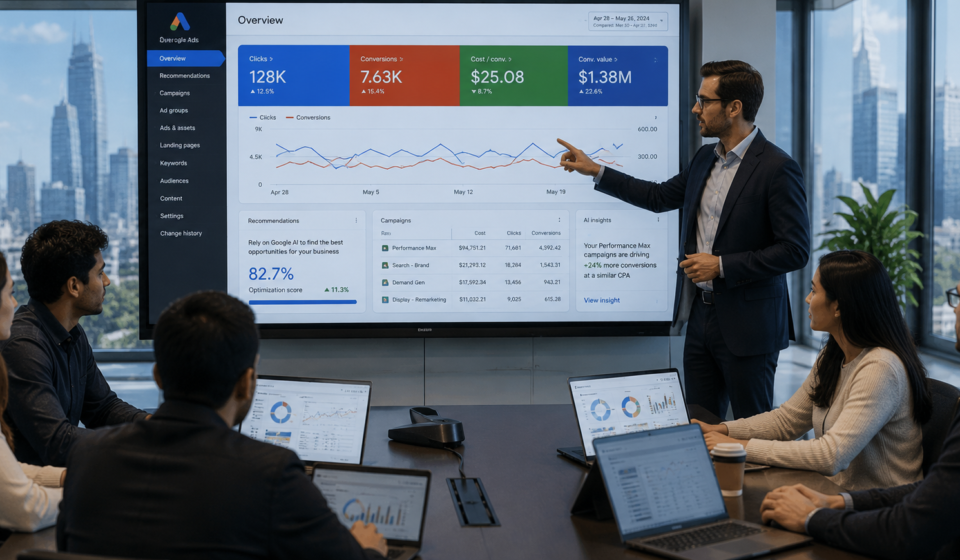
What Google Ads Looks Like When AI Takes the Wheel – And Why Your Old Playbook Is Already Obsolete

Most advertisers are still treating Google Ads the way they did in 2019. They pick keywords. They write three headline variations. They set a bid. They wait.
Meanwhile, the platform running underneath them has changed completely.
Google has quietly rebuilt its entire advertising engine around AI. Not AI as a feature. AI as the foundation. And the advertisers who understand what that actually means are seeing results that look almost unfair compared to those still running campaigns the old way.
This is not a post about Google’s AI tools and how to use them. You can find that anywhere.
This is about what changes in your results when you genuinely understand how AI is running your campaigns now, what it needs from you to perform well, and where it consistently fails without the right human input.
The Shift Nobody Explained Properly
When Google introduced Smart Bidding years ago, most advertisers treated it as optional. Some used it, some didn’t. The results were mixed. People wrote blog posts comparing manual CPC to Target CPA and called it a day.
That era is over.
Today, if you are running a Google Ads campaign, AI is already making decisions for you whether you invited it or not. The question is not whether to use AI in your Google Ads. The question is whether you are feeding it the right information and setting the right conditions for it to make good decisions.
Google’s AI now controls bid adjustments in real time based on hundreds of signals at once – device, location, time, search history, browsing behavior, audience membership, and more. No human can process that at the speed an individual auction requires. This is the part most advertisers accept.
What they do not fully accept is what this means for their role. Your job in Google Ads has changed. You are no longer the one making bidding decisions. You are the one setting goals, providing context, and feeding the system with data it can actually learn from.
If you want to understand more about how AI is reshaping the entire marketing landscape beyond just paid ads, the AI in Marketing section on AI Overview Search covers this shift in depth.
What AI in Google Ads Actually Controls Today
Bidding – The Decision You Are No Longer Making
Smart Bidding is not a setting you turn on. It is the default operating mode of modern Google Ads. When you select Target CPA, Target ROAS, Maximize Conversions, or Maximize Conversion Value, you are handing bid control to an auction-time AI that recalculates the right bid for every single impression.
The result in practice: advertisers who switch from manual bidding to properly configured Smart Bidding with sufficient conversion data typically see 15 to 30 percent improvement in cost per conversion within 60 days. That number comes from campaign patterns observed across industries – not a guarantee, but a consistent directional result when the setup is correct.
The setup being correct is the hard part. The AI needs at least 30 to 50 conversions per month to learn effectively. If you do not have that volume, the algorithm is essentially guessing. And a guessing AI will spend your budget confidently in the wrong direction.
Ad Creation – Responsive Search Ads and What They Are Actually Doing
Responsive Search Ads let you provide up to 15 headlines and 4 descriptions. Google’s AI tests combinations and learns which pairings drive the best results for different searchers.
But here is what most advertisers miss: the AI is not equally testing everything. It prioritizes combinations with higher predicted click-through rate based on the search query. If your headlines are too similar to each other, the AI has less to work with. If they are too generic, it has nothing interesting to test.
The advertisers getting the strongest RSA performance are writing headlines that cover genuinely different angles – emotional, functional, price-focused, urgency-based, and benefit-specific – so the AI has real variety to optimize from.
A campaign with 15 distinct, high-quality headlines outperforms one with 15 mediocre variations every time. The AI multiplies what you give it. It does not fix weak creative.
Audience Targeting – The Signals You Are Not Thinking About
Google’s AI uses audience signals to find the people most likely to convert, but many advertisers still think of audience targeting as a list they build manually. That is the old model.
Today, you add audience signals as suggestions, not constraints. You tell the AI “people like these tend to convert well” and the AI uses that as a starting point, then expands outward to find similar profiles you never would have targeted manually.
The advertisers leaving the most money on the table are those who restrict audience targeting so tightly that the AI cannot discover new converters. Conversely, giving the AI zero audience signals and expecting it to figure everything out from scratch wastes the first weeks of a campaign on pure exploration.
The right approach is a middle path: give strong signals based on your actual customer data, then let the AI expand from there.
The Results That Show Up When You Get This Right
This is the section worth paying attention to because the improvements are not incremental. They are structural.
When Smart Bidding is running with sufficient conversion data and proper goal setup, the AI adjusts bids based on real-time context signals that simply did not exist in manual campaigns. A search happening at 11 PM on a mobile device in a specific location from a user who visited your site twice last week gets a completely different bid than the same keyword searched at 9 AM on a desktop by someone with no prior history. That level of personalization at auction speed produces measurably better efficiency.
Advertisers who also consolidate their campaigns – giving AI more data per campaign rather than splitting budgets across dozens of narrow ad groups – consistently report lower CPAs over 90-day periods. The AI learns faster when it has more signal.
On the creative side, campaigns using RSAs with strong headline variety and asset group diversity (for Performance Max) regularly achieve 20 to 40 percent higher click-through rates compared to campaigns where all headlines say roughly the same thing.
If you are curious how AI is producing similar compounding improvements in other performance areas, this piece on how AI improves Google Ads performance goes deeper into specific campaign mechanics.
Where the AI Fails Without You
This is the part Google does not advertise.
The Conversion Tracking Problem
AI in Google Ads is only as good as the conversion data it receives. If your conversion tracking is broken, misconfigured, or tracking the wrong actions, the AI optimizes for those wrong actions at scale. It will spend your entire budget confidently doing the wrong thing.
This happens more often than most advertisers realize. Double-counted conversions, firing on page loads instead of form submissions, tracking micro-conversions like button clicks as primary conversions – all of these corrupt the learning and produce campaigns that look active but are optimizing toward outcomes that do not match your actual business goals.
Before you think about AI optimization, audit your conversion tracking. Every other AI capability in your campaign depends on this being clean.
The Goal Alignment Problem
Telling Google to maximize conversions sounds simple. But if the AI is maximizing for leads and your business closes 3 percent of leads into paying customers, the AI has no visibility into that 3 percent. It will chase lead volume and call it success, even if the leads have no commercial value.
The advertisers getting the best results from AI-powered campaigns are feeding offline conversion data back into Google Ads. When a lead becomes a customer, that signal gets imported. The AI learns which lead characteristics actually predict revenue, not just which searches predict form submissions.
This one change – closing the loop between ads data and actual sales outcomes – regularly produces dramatic shifts in lead quality without changes in lead volume.
The Creative Bottleneck
Performance Max campaigns, Google’s most AI-driven campaign type, can serve ads across Search, Display, YouTube, Gmail, and Maps. The AI decides where, when, and to whom. Your job is to provide the assets.
The AI cannot compensate for bad creative. If your images are stock photos that look like every other advertiser’s stock photos, the AI will serve them and they will underperform. If your ad copy reads like it was written to check compliance boxes rather than connect with a real person, the click-through rate will reflect that.
The campaigns producing the best Performance Max results are giving the AI genuinely differentiated creative: real customer photos, specific benefit statements, clear emotional hooks, and video assets that communicate the value in the first three seconds.
For a broader look at how AI tools are transforming marketing output beyond ads specifically, the AI in Marketing category covers the full picture.
The Practical Shift You Need to Make Now
Most advertisers who are struggling with Google Ads AI are struggling because they are still trying to control things the AI now handles better, while neglecting the things only humans can provide.
The AI handles bid math. You handle goal setting.
The AI tests creative combinations. You provide creative variety worth testing.
The AI expands audience reach. You define the signals that tell it who your best customers look like.
The AI optimizes toward your conversion events. You make sure those conversion events actually represent business value.
This is a fundamentally different job than running Google Ads was five years ago. The skill that mattered then was tactical precision: the right keywords, the right bids, the right match types. The skill that matters now is strategic setup: clean data, aligned goals, strong creative inputs, and the discipline to let the AI learn without constantly overriding it.
Advertisers who keep interrupting their AI-powered campaigns to make manual adjustments are the ones who report the worst results. Every time you change a bidding strategy mid-learning period, you reset the algorithm’s progress. The AI needs consistency to learn. You can evaluate and adjust strategy, but you have to do it at intervals that respect the learning cycle.
Understanding AI trends in business more broadly is useful context here. The same pattern appears across industries — AI performs best when humans define clear goals and provide quality inputs rather than trying to replicate human decision-making at every step. You can read more about how this plays out across different sectors in the AI in Business section.
What This Means for Your Google Ads Strategy in the Next 12 Months
Google is not slowing down on AI integration. The direction is clear: more automation, more AI-driven campaign types, less manual control over individual decisions.
Performance Max has already absorbed much of what was previously separate campaign types. Broad match keywords combined with Smart Bidding now behave in ways that would have seemed aggressive and risky under manual bidding, but regularly outperform tight exact-match setups when properly configured.
The advertisers who will have an advantage over the next year are not the ones who resist this shift. They are the ones who accept the new division of labor – where the AI handles the auction-moment decisions and the human handles strategy, measurement quality, and creative direction.
The companies investing in better creative, cleaner data pipelines, and more sophisticated goal structures are the ones pulling ahead. The ones spending energy trying to regain manual control over bidding and targeting are the ones watching their results decline.
This is not about trusting AI blindly. It is about understanding what AI in Google Ads actually needs to produce good results – and providing exactly that.
If you are thinking about how AI is changing your broader marketing approach beyond just paid ads, the work happening in AI in Marketing and across AI Tools and Reviews is worth exploring. The same shift in human-AI collaboration that is changing Google Ads is happening across every marketing channel at once.
Final Thoughts
AI in Google Ads is not a feature. It is the engine.
The advertisers winning with it are not winning because they found a clever setting or a smart workaround. They are winning because they understood that their role changed – from making execution decisions to setting up the conditions for AI to make good execution decisions.
Clean conversion tracking. Aligned business goals. Strong creative inputs. Sufficient data volume. Strategic patience.
That is the new job description for a Google Ads manager.
The old playbook is not just outdated. It actively works against you when applied to a system that runs on AI logic. Switching is not optional. The question is how quickly you make the shift and whether you understand what the new game actually requires.
If you want to stay ahead of how AI is reshaping paid advertising and marketing as a whole, AI Overview Search covers the trends, tools, and practical strategies across every major area where AI is producing measurable change.