

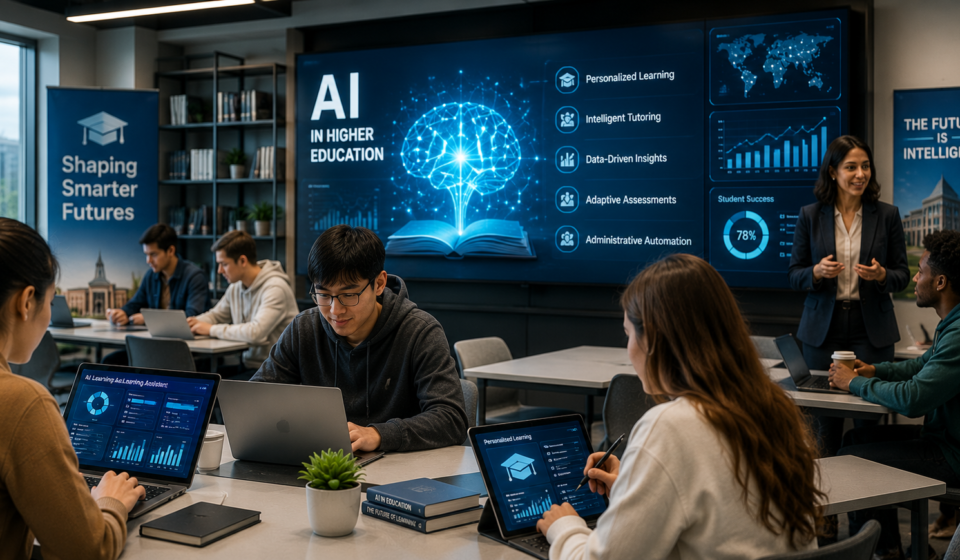

I have spent twenty-one years working in and around higher education. I started as a teaching assistant at a research university, moved into curriculum design, spent several years advising institutional strategy at two different colleges, and have spent the last four years watching closely as AI arrived in classrooms, faculty offices, admissions departments, and board rooms simultaneously.
The conversation about AI in higher education has mostly been loud and mostly been wrong. It has been dominated by two camps: the panicked traditionalists who believe universities are collapsing under the weight of student-submitted AI essays, and the breathless futurists who claim that lecture halls will be empty within a decade and every course will be taught by a personalized AI tutor. Neither of those pictures is accurate. Neither one is useful.
What is actually happening is more complicated, more interesting, and more consequential than either side acknowledges. This article is about what I have seen happen on the ground over the past several years, where I think the genuine trends are pointing, and what students, educators, and institutions need to understand about the future they are already living inside.
How Higher Education Got Here – and Why This Moment Is Different
Universities have absorbed new technologies before. The internet did not kill lectures. The learning management system did not replace professors. The massive open online course movement of the early 2010s was going to democratize higher education and render physical campuses unnecessary – and then it mostly did not. Institutions adapted, incorporated what was useful, and continued.
I understand why many experienced educators look at AI through that same lens. Another wave of technological enthusiasm, another round of disruption predictions, another adjustment period followed by a return to roughly the status quo. I held that view myself for longer than I should have.
What changed my mind was not the technology itself. It was watching what students were doing with it without being asked or instructed to. When a technology gets adopted organically at that speed and at that scale, before any institution has had time to form a policy about it, you are not looking at a tool that needs to be integrated. You are looking at a behavior shift that has already happened and that policy is now chasing.
That is a fundamentally different situation from previous waves of educational technology. And it changes the question from whether AI will matter in higher education to how institutions will choose to respond to the fact that it already does.
The Trends That Are Actually Real
Personalized learning is moving from promise to practice
For as long as I have been in education, personalized learning has been a goal that was technically impossible to achieve at scale. A single professor teaching 300 students cannot tailor the pacing, difficulty, and approach of instruction to each individual learner. The aspiration was genuine. The execution was always constrained by human bandwidth.
AI is beginning to change this in ways that are measurable rather than theoretical. Adaptive learning platforms powered by AI now track individual student performance on a granular level – not just quiz scores, but which types of questions a student consistently struggles with, how long they spend on specific concepts, where their comprehension drops off during a reading sequence. The system adjusts the sequence and difficulty of material in response to that data.
The results at institutions that have implemented these platforms seriously – not as a pilot program for one course, but as a core part of introductory curriculum – are showing meaningful improvements in student retention and performance, particularly among first-generation students who historically struggle with the self-direction that university learning demands.
If you want context on how AI is reshaping learning outcomes more broadly, our AI in Education overview covers the wider picture.
The caveat is significant: adaptive learning works best in structured, knowledge-acquisition subjects. Mathematics, foundational sciences, language learning, data literacy. It is far less effective in seminar-style courses built around discussion, interpretation, and the development of judgment. The technology is a genuine improvement in one important domain of education. It is not a replacement for teaching at large.
The writing crisis is real – and it is not about cheating
The dominant conversation about AI and student writing has been about academic integrity. Whether students are submitting AI-generated essays. Whether detection tools work. Whether universities should ban AI use or require disclosure.
This conversation is not unimportant, but it has obscured the more significant issue underneath it. The real question is not whether students are cheating with AI. The real question is what writing is for in higher education, and whether the current model of assessing it still makes sense in a world where AI can produce competent prose on demand.
I have talked to instructors who are angry about AI-generated submissions. I have also talked to instructors who have taken the opposite position: that if a student can use AI to produce a coherent 2000-word essay on a topic, the assignment itself may not have been measuring what they thought it was measuring. The latter position is uncomfortable, but it is the more intellectually honest one.
Eighteen years of working with students taught me that writing assignments in their most common form test a mixture of things: knowledge of course content, ability to construct an argument, writing fluency, and the discipline to sit down and produce something under a deadline.
AI collapses one of those four dimensions entirely. Institutions that respond only by policing the collapse are missing the larger opportunity to redesign what they are actually trying to assess.
Faculty workload is being redistributed, not reduced
One of the most consistent things I have heard from faculty over the past two years is that AI has saved them time in some areas and created new demands in others, and that the net change is roughly neutral at best. This is not what the optimistic version of the AI story predicted, and it is worth understanding why.
AI has genuinely helped with certain administrative and preparatory tasks. Drafting course materials, preparing quiz questions, generating first passes at rubrics, summarizing student feedback patterns across a large class, responding to routine student email inquiries. These are real time savings for faculty who have adopted the tools thoughtfully. For a look at which specific AI tools are proving most useful in professional practice, our AI Tools and Reviews section has current assessments worth reading.
But AI has simultaneously created new demands. The policy environment around academic integrity has required more explicit assignment design, more detailed documentation of learning objectives, more work explaining to students what is and is not permitted in each context.
Assessment redesign – moving away from traditional essays toward oral examinations, process portfolios, and in-class demonstrations – takes significant faculty time to build well.
The picture that emerges is not of AI liberating faculty from administrative burden so they can focus on teaching. It is of AI shifting where the work sits while keeping the total workload roughly stable. For some faculty in some disciplines, the shift has been positive. For others, particularly those in fields where the assessment redesign burden is heaviest, it has added stress without obvious compensating benefits.
Admissions and student services are being transformed quietly
While the public conversation has focused on the classroom, AI is making some of its deepest inroads in the parts of higher education that students interact with outside of instruction.
Admissions offices at large universities are using AI to manage application volumes that have become impossible to process manually, to identify at-risk students early in the enrollment funnel, and to personalize outreach to prospective students based on behavioral signals.
Financial aid offices are using AI to flag students who may be eligible for additional support they have not applied for. Student success teams are using predictive models to identify which enrolled students are most likely to drop out before it becomes visible in their grades.
These applications are less headline-generating than the debate over AI essays. They are also, in aggregate, likely to have a larger impact on the equity and accessibility of higher education than any classroom tool.
Early intervention systems built on AI-driven analytics have shown meaningful improvements in retention rates at institutions that have implemented them with appropriate human follow-through. The technology identifies the pattern. A human advisor makes the call. The combination works in ways that neither does alone.
The Trends That Are Overstated
The death of the lecture
Every few years, someone announces that the lecture format is dead. It has been killed by television, by the internet, by video streaming, and now by AI. In practice, it keeps surviving.
The lecture persists not because institutions are resistant to change but because it does something that asynchronous and personalized formats do not: it creates a shared experience. Sitting in a room with a knowledgeable person who is thinking through ideas in real time, adjusting to the room, following a question somewhere unexpected, and modeling the intellectual process of working with difficult material is genuinely different from watching a recorded explanation or receiving an AI-tutored response.
Some of what happens in a good lecture cannot be disaggregated into its component parts and delivered more efficiently. The inefficiency is part of the value.
That said, AI is rightly challenging the bad lecture. The professor who reads verbatim from slides for ninety minutes, covering material the student could learn more efficiently from a well-structured online resource, is performing a function AI actually can replace. The question is not whether lectures will survive – some will, some should not have survived before AI – but which ones, and why.
Universal AI tutoring as the great equalizer
The most optimistic version of the AI in education story goes something like this: students in under-resourced schools and developing countries will now have access to the same quality of tutoring as students at elite institutions, because AI can provide personalized, expert-level support to anyone with a device and an internet connection.
This is genuinely appealing. It is also incomplete in ways that matter.
The students who benefit most from personalized AI tutoring are, consistently, the students who already have strong study habits, clear learning goals, and the ability to self-direct their education. These are the students who were already relatively well-served by existing educational systems.
The students who are most likely to be left behind by those systems – students dealing with food insecurity, unstable housing, learning differences, mental health challenges, or simply no model of what university-level work looks like in their home environment – are the students for whom an AI tutor is least likely to close the gap. They need mentorship, community, and human support that AI cannot substitute for.
This is worth naming directly, even in an article that is broadly optimistic about AI’s role in education.
Related Reading
- AI in Education – The Full Overview
- Best AI Tools for Students – What Actually Helps and What Wastes Your Time
- AI Skills That Employers Are Actually Hiring For
What This Means for Students Right Now
If you are currently a student in higher education, the most important thing to understand is that the credentials you earn still matter – but the skills that make those credentials valuable are shifting.
The ability to produce a polished essay on a given topic is no longer a differentiating skill. AI can do that. The ability to ask the right questions about a complex problem, synthesize information from multiple conflicting sources, exercise judgment about what matters and why, communicate credibly under pressure, and work effectively in collaboration with other people – none of those things have been automated. All of them have become more valuable precisely because the baseline cognitive tasks around them have been.
Students who use AI as a replacement for thinking will leave university with a credential and a gap. The problem will not show up until they are in a professional environment that requires them to produce something original under conditions where they cannot offload the thinking to a tool.
Students who use AI as an amplifier – to cover more ground, to pressure-test their own reasoning, to move faster through the foundational material so they have more time for the harder interpretive work – will have a genuine advantage.
The distinction is not always easy to maintain, especially under deadline pressure. But it is the most important one to hold onto.
It is also worth being deliberate about which AI skills you develop now, because employers are paying attention to them. Our post on AI skills that employers are actually hiring for is worth reading if you are thinking about how your education connects to the job market.
What This Means for Educators
The educators I have seen adapt best to AI are not the ones who have the strongest opinions about it. They are the ones who became curious about what it could do before deciding how to respond to it.
The defensive posture – more proctored exams, more plagiarism detection, more explicit prohibitions – is understandable. It is also, as a long-term strategy, exhausting and ultimately futile. AI capabilities are advancing faster than detection methods can keep up with. Every semester, the tools students have access to are more capable than they were before. An institutional strategy built primarily on detection and prohibition is spending energy on a race it cannot win.
The more productive approach is to ask honestly: which of my assignments are testing what I think they are testing, and which ones would an AI completing them successfully reveal as having been measuring the wrong thing all along? That question is uncomfortable. It is also the most generative one available right now.
Assessment redesign is where the real work is. Oral components, process documentation, in-class work, and collaborative projects that require demonstrated real-time thinking are all more durable than take-home essays in a world where text generation is cheap. They are also, not coincidentally, closer to what professional environments actually demand of graduates.
What This Means for Institutions
Universities are slow-moving institutions by design. Governance structures that require faculty senate approval for curriculum changes, accreditation cycles measured in years, budget processes that lock in priorities two or three years in advance – none of these are well-suited to responding to a technology that is changing meaningfully every few months.
The institutions that will navigate this period best are not the ones that move fastest but the ones that are clearest about what they are trying to protect. The core value proposition of a residential university – the intellectual community, the mentored development of judgment, the human relationships that shape how graduates think and who they become – is genuinely not threatened by AI. It is, if anything, thrown into sharper relief by it.
The parts of higher education that AI does threaten are the parts that were already providing thin value: rote knowledge transmission that could be delivered more efficiently through self-paced online learning, administrative processes that consume faculty and staff time without commensurate benefit to students, assessment structures that measure compliance rather than genuine understanding.
A university that is clear-eyed about that distinction – that can articulate honestly what it does that AI cannot replicate, and can redesign the parts of itself that AI reveals to have been doing poorly all along – is in a strong position. A university that defends every existing practice equally will burn energy and credibility defending things that did not deserve defending.
You Might Also Like
- AI vs Human Jobs – Will Artificial Intelligence Replace Human Workers?
- What Are AI Agents and Why Is Everyone Talking About Them?
- How Beginners Are Earning With AI – No Experience, No Degree, No Excuses
The Five Shifts I Expect to See Over the Next Decade
Based on eighteen years of watching how higher education responds to change, and two years of watching it respond specifically to AI, here is where I think the genuine long-term trends are pointing.
Credentials will shift from input-based to output-based
The traditional university credential certifies that a student sat in courses for a specified number of hours and passed assessments designed by faculty in those courses. AI is accelerating a shift toward credentials that certify what a graduate can actually do – demonstrated competencies rather than completed seat time. Competency-based education existed before AI. AI is making the argument for it more urgent, because if the inputs can be partially substituted by machine assistance, the only thing that matters is whether the output – the actual demonstrated capability – is real.
The research university model will bifurcate further
Research-intensive universities, where faculty are generating new knowledge and students have access to that process directly, are differentiated from AI in a way that teaching-focused institutions without active research culture are not. The experience of learning from someone who is genuinely at the frontier of their field, working through questions that have not been answered yet, is not reproducible by a language model trained on existing knowledge.
That form of higher education has a durable value proposition. Teaching-focused institutions that compete primarily on knowledge transmission will face more pressure to justify their cost relative to AI-assisted alternatives.
AI literacy will become a baseline admission expectation
Within a decade, I expect selective universities to screen for AI literacy the way they currently screen for digital literacy or data literacy. Not because AI tool use is inherently valuable, but because students who understand how to work with AI thoughtfully – who can evaluate its outputs critically, use it to extend their own thinking rather than replace it, and recognize its limitations – will be more capable learners and more productive contributors to an intellectual community.
This is already beginning to show up in how some employers approach entry-level hiring. Universities will follow. Our overview of AI skills employers are paying for gives a current read on where that bar is being set.
Faculty roles will specialize further
The model of a single faculty member who designs curriculum, delivers instruction, assesses student work, advises students, and conducts research simultaneously was always an awkward bundle of distinct skill sets. AI is disaggregating some of those functions in ways that will accelerate the specialization already underway. Curriculum design supported by AI tools, instructional delivery that leverages adaptive platforms for structured content, and human faculty focused on discussion facilitation, mentorship, and research supervision may look more like distinct roles than they currently do.
This is not necessarily a loss – but it requires rethinking what faculty careers look like and how they are compensated.
The most important thing universities teach will become clearer
Counterintuitively, AI may force higher education to become more explicit about what it has always done best and least efficiently: teach people how to think. Not what to think, not the specific content of any given field, but the disposition and capacity to encounter difficult questions, sit with uncertainty, reason carefully, argue honestly, and revise your position in the face of better evidence. These are things AI cannot teach because they are things AI cannot do.
A university that takes that seriously, and designs its entire experience around developing that capacity in every student, has a future that is genuinely secure from technological substitution. Whether enough institutions have the courage to make that case clearly and build toward it deliberately remains to be seen.
Further Reading
- How Much Money Can You Realistically Earn Using AI? A Data-Driven Analysis
- AI Agents Replacing Jobs – The Truth About What Is Really Happening to Your Career
- The Future of AI – Where We Are Actually Headed
Where I Land After Eighteen Years in the Room
I have been in faculty meetings where professors argued passionately that AI would destroy academic integrity entirely. I have been in strategy sessions where administrators argued that AI would render entire departments obsolete within five years.
I have watched students use AI with sophistication and students use it as a pure shortcut. I have seen institutions that responded to AI thoughtfully and institutions that responded with policies they could not enforce.
What eighteen years teaches you is that the most dramatic predictions about educational change rarely come true on the timeline their proponents claim, and the most dismissive predictions are almost always wrong too. The change that matters most tends to happen in the middle – slower than the excited version says, faster and deeper than the resistant version acknowledges.
AI in higher education is that kind of change. It is already real. It is already consequential. It is not going to end universities, and it is not going to leave them unchanged.
The institutions that will serve students best over the next decade will be the ones that were honest enough to distinguish between what they were doing that was genuinely valuable and what they were doing because it had always been done that way, and brave enough to let AI be the prompt for that distinction.
That is not a comfortable process. It rarely is. But it is the right one.
Disclaimer: This article reflects personal observations and experience from working in and around higher education over eighteen years. It is intended for informational purposes only and does not represent the official position of any institution. Views expressed are the author’s own.