



Have you ever asked ChatGPT, Gemini, or another AI tool a question and received a vague, generic, or completely inaccurate response?
If so, you’re not alone.
Many people believe AI tools are unreliable because they don’t always produce the results they expect. In reality, the problem usually isn’t the AI, it’s the prompt.
AI models don’t read your mind. They generate responses based on the instructions you provide. The clearer and more detailed your prompt, the better the output.
Whether you’re using AI for content writing, coding, research, marketing, or business tasks, learning how to write effective AI prompts is one of the most valuable skills you can develop.
What Are AI Prompts?
An AI prompt is the instruction you give an AI model to generate a response.
It can be as simple as asking a question or as detailed as providing a role, context, objectives, formatting instructions, and examples.
Think of AI like a new employee. If you say, “Write a blog,” you’ll probably receive an average result. But if you explain the audience, tone, word count, keywords, and goal, the output becomes far more useful.
The quality of your prompt directly influences the quality of the response.
Why Most AI Prompts Fail
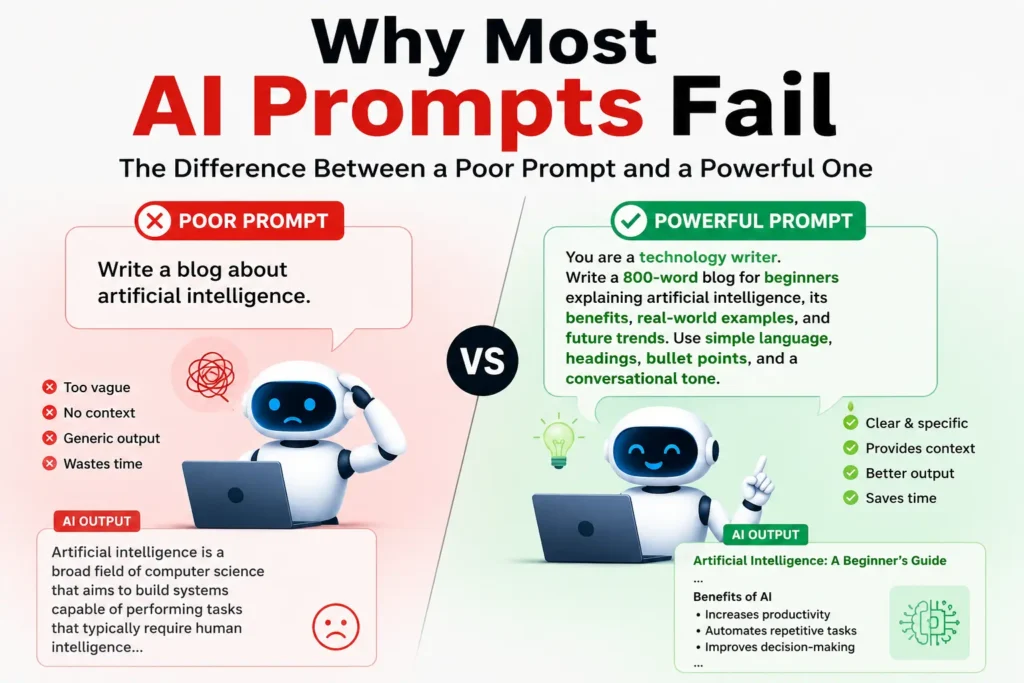
1. The Prompt Is Too Vague
One of the biggest mistakes people make is asking broad questions.
Weak Prompt
Write an article about AI.
The AI has no idea who the audience is, how long the article should be, or what information matters most.
Better Prompt
Act as an SEO content writer. Write a 900-word article about AI productivity tools for small business owners. Use H2 headings, include practical examples, and maintain a conversational tone.
The second prompt gives the AI enough direction to create something much closer to your expectations. For a deeper look at realistic earnings and strategies, our Make Money With AI: Proven Methods Guide offers the specificity you need to move from “generic” to “actionable.”
2. Not Providing Enough Context
AI doesn’t know your business, writing style, or project goals unless you explain them.
For example, asking AI to “write a product description” will produce a generic result.
Instead, include details such as:
- Target audience
- Product features
- Brand voice
- Desired tone
- Call to action
The more context you provide, the more personalized the response becomes.
3. Expecting AI to Be Perfect
AI is incredibly capable, but it isn’t always accurate.
It can misunderstand instructions, overlook important details, or occasionally generate incorrect information.
That’s why every AI-generated draft should be reviewed before publishing or sending it to a client.
Treat AI as a skilled assistant, not the final decision-maker.
Weak Prompt vs Strong Prompt
| Weak Prompt | Improved Prompt |
|---|---|
| Write a blog about AI. | Write a 900-word SEO blog about AI prompts for beginners. Include examples, FAQs, and practical tips. |
| Explain SEO. | Explain SEO to a small business owner using simple language and real-world examples. |
| Write an email. | Write a professional follow-up email to a client who hasn’t responded in one week. Keep it under 150 words. |
Best Practices for Writing AI Prompts
To consistently receive better responses, follow these tips:
- Be specific about your goal.
- Assign a role to the AI.
- Provide enough context.
- Define the desired format.
- Mention your target audience.
- Set word count or length limits.
- Ask for examples where appropriate.
- Review and fact-check the output before using it.
Prompt writing is an iterative process. If the first response isn’t ideal, refine your prompt instead of starting over.
Why Prompt Engineering Matters
Prompt engineering isn’t just for developers or AI researchers.
Content creators, marketers, freelancers, business owners, students, and professionals can all benefit from learning how to communicate effectively with AI.
Better prompts help you:
- Save time.
- Produce higher-quality content.
- Reduce repetitive editing.
- Improve research efficiency.
- Generate more relevant ideas.
- Create consistent workflows.
Real-World Application: The Professional Path
If you are effectively using AI prompts, you aren’t just getting better text; you are building a scalable workflow. Whether you are automating client emails or refining complex data analysis, the prompt is your leverage. For those ready to take their AI usage to a professional level, we have a comprehensive analysis on how to Earn Money Using AI that details how to translate these skills into real-world results.
FAQs
Q: Why does my AI give me factual errors?
AI models generate text based on patterns, not verified facts. Always verify critical statistics, dates, and quotes.
Q: Should I use XML tags in my prompts?
Yes. For complex tasks, using tags like <context> or <instructions> helps the model distinguish between different parts of your prompt.
Q: How do I stop the AI from being too “wordy”?
Add explicit constraints in your output guidelines, such as “Keep responses concise” or “Use a maximum of 200 words”.