


AI for Living Room: How I Transformed My Lounge into a Smarter, More Comfortable Space

There’s a moment every evening when I walk into my living room and just say, “Hey, movie time.”
The lights dim to a warm amber, the TV switches on and jumps straight to my watchlist, the soundbar comes alive, and the thermostat nudges itself down two degrees. No remote control juggling. No fiddling with five different apps. Just one phrase – and the room does the rest.
That’s what AI for living room spaces looks like in 2026. Not the sci-fi fantasy of a decade ago, but something genuinely useful, accessible, and – if you set it up right – deeply satisfying to live with every day.
If you’ve been curious about upgrading your lounge with intelligent technology, this article covers everything from the best devices to real-world setup ideas, honest problems you’ll face, and where this all is headed next.
Why AI Is Changing the Living Room First
The living room isn’t just a room.
It’s the most used room in most homes and that makes it the perfect testing ground for AI-powered home devices.
Unlike kitchens or bedrooms, living rooms are inherently social and multi-purpose. You need lighting that adapts to mood, entertainment that’s effortless to control, and audio that responds to how many people are in the room. AI does all of this better than any manual system ever could.
Early smart home tech was honestly clunky. You’d tap through apps, set rigid schedules, and still end up reaching for the remote anyway. What’s changed is the intelligence layer – devices now learn your habits, anticipate needs, and respond to natural language. That shift is what makes a smart AI living room setup feel less like a project and more like a lifestyle.
The Best AI Gadgets and Devices for Living Rooms
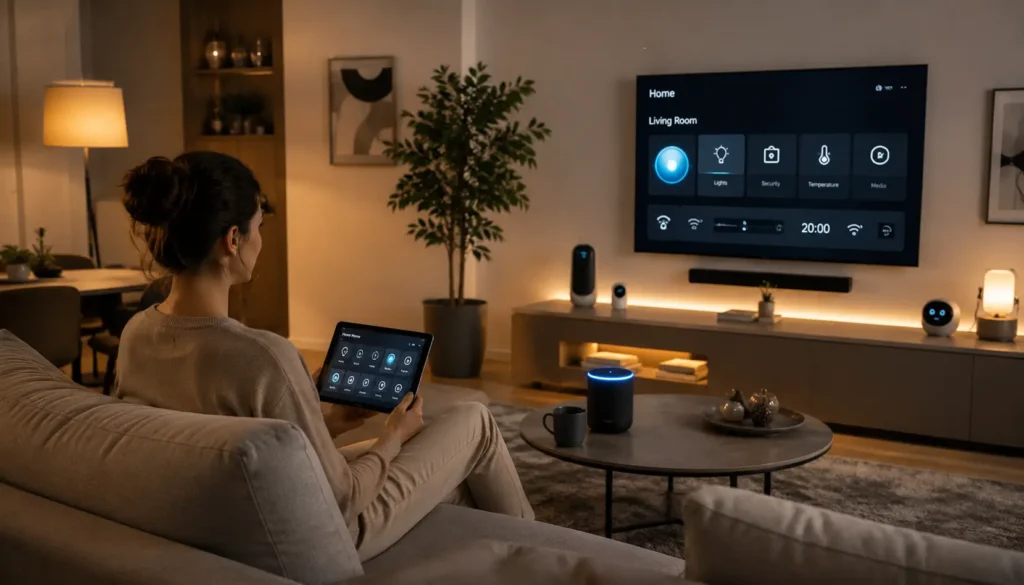
1. Voice Assistants: The Brain of the Operation
A voice assistant living room setup starts with choosing your ecosystem. Google Nest Hub Max, Amazon Echo Show, or Apple HomePod – each has its strengths.
I’ve run Google’s ecosystem for two years now, and the contextual understanding has improved enormously. You can say “make it brighter” after already saying “set the lights to reading mode,” and it understands the context without starting over. That kind of conversational flow makes daily use actually enjoyable.
Practical tip: Place your primary smart speaker centrally in the room, not in a corner. Far-field microphone pickup matters more than people realize, especially in larger living rooms.
2. AI TV Automation and Smart Entertainment Systems
AI TV automation has come further than most people expect. Modern smart TVs from Samsung, LG, and Sony now include on-device AI processors that handle:
- Content recommendations based on viewing history and time of day
- Automatic picture calibration – adjusting brightness, contrast, and color based on ambient light in the room
- Scene detection – some LG OLED models literally analyze each scene and optimize settings in real time
Pair your TV with a smart entertainment system (Sonos, for instance, integrates beautifully with most voice assistants) and you’ve got a setup that feels genuinely curated.
One thing I discovered through trial and error: link your streaming apps through your voice assistant ecosystem rather than running them independently. This creates a unified control layer, so you can say “play the new season of that chef show on Netflix” and it actually works.
3. Smart Lighting AI: The Underrated MVP
If there’s one upgrade that changes how a living room feels more than anything else, it’s smart lighting AI.
I use Philips Hue with adaptive lighting enabled. Throughout the day, the color temperature shifts automatically – cooler and energizing in the morning if I’m working from the sofa, warmer and softer as evening approaches. When I start a movie, a routine drops everything to 8% warm white. When I pause, it bumps back up gently.
None of this required me to program anything complex. After a few weeks of manual adjustments, the system learned what I preferred. That’s the “AI” part working quietly in the background.
Setup idea worth stealing: Create a “Focus” scene for when you’re working in the living room and a “Dinner Party” scene for guests. Name them something you’ll actually say out loud, because you’ll be triggering them by voice.
4. AI-Powered Soundbars and Audio
Sonos Arc and Samsung’s Q-series soundbars now use AI to analyze room acoustics automatically. Point a microphone at your listening position, run a calibration, and the system adjusts EQ, delay, and channel balance to suit your specific room — its size, furniture, even the number of soft surfaces.
This is AI home entertainment doing something no manual EQ setting ever could: adapting to your physical space rather than a generic preset.
Real AI Living Room Setup Ideas Worth Trying
You don’t need to rebuild your entire room at once. Here’s how to approach it in layers:
Layer 1 – Start with voice + lighting. Get a smart speaker and two or three smart bulbs. Build your first routines. Get comfortable with voice control before adding complexity.
Layer 2 – Upgrade your entertainment hub. Add a smart TV or a streaming stick with voice integration. Connect your soundbar if you have one.
Layer 3 – Add sensors and automation. Motion sensors can trigger “welcome home” lighting. Presence detection (available in some Google and Amazon devices) can dim lights when the room’s empty and restore them when you return.
Layer 4 – Connect everything into scenes. This is where a smart AI living room setup really clicks. “Movie mode,” “game night,” “morning news,” “kids’ playtime” – single commands that shift the entire room’s state simultaneously.
Real Benefits I’ve Noticed Living With AI in My Living Room
I won’t oversell this. But these are genuinely real:
- Less friction = more relaxation. When entertainment is effortless, you actually unwind faster.
- Energy savings. My smart lighting reduced my living room electricity use noticeably. Lights that turn off when the room is empty add up.
- Accessibility improvements. For older family members or guests with mobility limitations, voice control is genuinely life-changing, not just convenient.
- Better sleep hygiene. Warm lighting cues programmed into evening routines help signal wind-down time naturally.
Common Problems (And How to Fix Them)
Problem: Voice commands are misunderstood. Fix: Rename your devices clearly and consistently. “Living room main light” is better than “lamp” or “light 1.” Avoid duplicate names across rooms.
Problem: Devices from different brands don’t talk to each other. Fix: Build within one ecosystem where possible (Google Home, Apple HomeKit, or Amazon Alexa). If mixing brands, use a hub like SmartThings or Home Assistant to bridge gaps.
Problem: Guests don’t know how to use anything. Fix: Create a simple “Guest” routine triggered by a physical button (Philips Hue has great button accessories). One tap sets everything to a sensible, accessible default.
Problem: Automation triggers at wrong times. Fix: Build in conditions. “Dim lights at 8pm” becomes “dim lights at 8pm if TV is on and motion is detected.” Conditional logic is available in most apps and makes routines dramatically smarter.
Where AI Living Room Technology Is Headed Next
The next two to three years will bring some genuinely exciting shifts.
Spatial awareness is arriving fast. Devices will soon detect not just whether someone is in the room, but where in the room, and adjust audio, lighting, and temperature zones accordingly.
Generative AI integration is moving into home devices. Imagine asking your living room assistant to “suggest a film based on my mood tonight” and receiving a genuinely personalized recommendation – not just a Netflix algorithm, but something that factors in your history, the time, even recent conversations.
Emotion-sensing environments are early stage but coming. Some research prototypes already adjust lighting and music based on detected stress levels. Whether that’s welcome or unsettling depends very much on your comfort level – but the technology is real.
For now, the most exciting thing happening is simply that AI for living room setups are becoming more seamless, more affordable, and more reliable than ever before.
Conclusion: Your Living Room Is Ready to Get Smarter
You don’t need to spend a fortune or have a technical background to bring genuine AI intelligence into your living room. Start small. Build routines that match your habits. Give it a few weeks to settle in.
What I’ve found – after a couple of years of iterating on my own setup – is that the best smart AI living room isn’t the one with the most devices. It’s the one where technology disappears into the background and the room just works, exactly the way you need it to, exactly when you need it.
That’s the promise of AI for living rooms. And increasingly, it’s the reality.
Frequently Asked Questions
1. What is the best AI device for a living room?
It depends on your ecosystem preference, but a smart speaker (Google Nest Hub, Amazon Echo Show, or Apple HomePod) paired with smart lighting is the best starting point for most people. These form the control layer that everything else builds on.
2. How do I set up a smart AI living room on a budget?
Start with a single smart speaker (around $50–$100) and two or three smart bulbs ($15–$30 each). Build one or two useful voice routines before investing further. You can create a genuinely functional AI living room setup for under $200.
3. Is AI TV automation worth it in 2026?
Yes, particularly the automatic picture calibration and content recommendation features on higher-end Samsung and LG models. Combined with voice assistant integration, AI TV automation removes most of the friction from daily entertainment use.
4. Can AI living room devices work without the internet?
Most AI-powered home devices require an internet connection for voice recognition and cloud-based processing. Some routines and local automations can work offline, but core AI features are cloud-dependent. A strong, reliable home Wi-Fi setup is essential.
5. Are AI living room setups safe and private?
Major platforms (Google, Amazon, Apple) offer privacy controls including muting microphones physically and reviewing/deleting voice history. It’s worth reviewing your privacy settings when setting up any voice assistant living room system. Local-processing alternatives like Apple HomePod offer stronger on-device privacy for those who prefer it.