



Let’s be direct. If your marketing agency is not using AI tools, you are not just behind the curve – you are handing your competitors an unfair advantage every single day.
The agencies growing fastest right now are not necessarily the ones with the biggest budgets. They are the ones that figured out which AI tools actually work in real client workflows, and which ones are just shiny distractions.
This guide cuts through the noise. Every tool mentioned here has real-world applications for agencies handling SEO, paid ads, content, social media, and client management.
Why Marketing Agencies Need AI Tools More Than Anyone
Marketing agencies operate under constant pressure. Tighter deadlines, demanding clients, shrinking margins, and a relentless need to produce creative output at scale. That combination is exactly where AI tools shine.
The best AI tools for agencies do not replace your team. They multiply what your team can do in a day. A copywriter using Jasper can produce five variations of ad copy in the time it used to take to write one. An SEO lead using Surfer can audit and optimize a page in under an hour. That is the practical reality.
And here is what most listicles miss: the value is not in any single tool. It is in how they connect across your workflow.
The Best AI Tools for Marketing Agencies
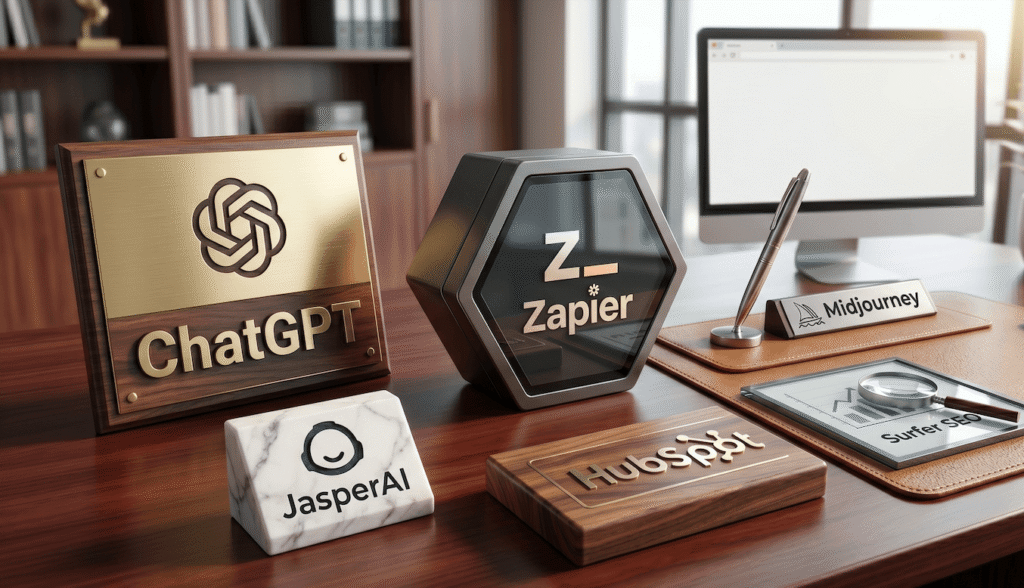
1. ChatGPT (OpenAI)
Still the most versatile tool in the stack. ChatGPT is not just a content writer – it is a thinking partner. Agencies use it for:
- Brainstorming campaign angles and headline variations
- Writing and debugging automation prompts
- Drafting client proposals and strategy decks
- Summarizing research and competitor analysis
The GPT-4o model handles complex reasoning, which makes it useful even for strategic work, not just content generation.
Best for: Content strategy, research, internal documentation, client communication drafts.
2. Jasper AI
Jasper was built specifically for marketing teams, and it shows. Unlike general-purpose tools, Jasper allows you to train it on brand voice, past content, and tone guidelines. For agencies managing multiple clients with distinct brand identities, this matters enormously.
It integrates with Surfer SEO directly, which means your writers can create SEO-optimized drafts without switching tabs.
Best for: Long-form blogs, email sequences, ad copy, brand-consistent content at scale.
3. Surfer SEO
Surfer is the go-to AI-assisted SEO tool for content-driven agencies. It analyzes top-ranking pages for any keyword and gives you a content score, semantic keyword suggestions, and structural recommendations in real time.
What makes it genuinely useful is the NLP-based content editor. Writers can see exactly what topics to cover and what depth is expected, based on what Google is already rewarding.
Best for: On-page SEO, content briefs, content audits, SERP analysis.
4. Midjourney (or DALL-E 3)
Visual content bottlenecks kill campaign timelines. Midjourney has become a serious production tool for agencies creating social assets, concept visuals, mood boards, and ad creatives. It is not perfect for every use case, but for rapid ideation and concept visualization, nothing comes close at this price point.
DALL-E 3 (inside ChatGPT) is the better option when you need tighter prompt control and faster iteration.
Best for: Social media visuals, concept art, ad creative testing, presentation graphics.
5. HubSpot AI Features
HubSpot has embedded AI across its CRM, email, and reporting tools. For agencies using HubSpot for client management, the AI writing assistant, predictive lead scoring, and automated reporting summaries are genuinely time-saving features, not just marketing.
Best for: Client CRM management, email marketing, automated reporting, lead nurturing.
6. Zapier + AI Integrations
Zapier itself is not an AI tool, but it becomes one when combined with OpenAI, Claude, or Gemini integrations. Agencies use Zapier AI workflows to auto-categorize leads, generate first-draft content from form submissions, and send personalised client updates without manual work.
Best for: Workflow automation, lead management, cross-tool data syncing.
Quick Comparison: Top AI Tools for Agency Use
| Tool | Best Use Case | Free Plan | Starts At |
|---|---|---|---|
| ChatGPT | Content, strategy, research | Yes | $20/month |
| Jasper AI | Brand-consistent copywriting | No | $39/month |
| Surfer SEO | SEO optimization | No | $79/month |
| Midjourney | Image generation | No | $10/month |
| HubSpot AI | CRM and email marketing | Yes | Free tier |
| Zapier AI | Workflow automation | Yes | $19.99/month |
Common Mistakes Agencies Make With AI Tools
Using too many tools at once is the fastest way to waste both money and time. Agencies often sign up for ten platforms, use three of them half-heartedly, and wonder why ROI is unclear.
Start with two or three tools that directly address your biggest bottleneck – usually content production or reporting – and build from there once those workflows are solid.
Another mistake: treating AI output as final output. Every AI-generated piece of content, copy, or image needs human review. The agencies that let AI go unchecked end up with brand inconsistencies and client complaints.
The Future of AI in Marketing Agencies
The next wave is agentic AI – systems that do not just generate content but actually complete multi-step tasks autonomously. Think of an AI agent that monitors a client’s ad performance, identifies underperforming campaigns, drafts revised ad copy, and alerts your team for approval – all overnight.
Tools like Claude, AutoGPT, and emerging platforms from HubSpot and Google are already moving in this direction. Agencies that build familiarity with these workflows now will have a significant operational advantage within the next 12 to 18 months.
Conclusion: Start Small, Scale Smart
The top AI tools for marketing agencies are not magic. They are leverage. The real competitive edge goes to agencies that use them consistently, integrate them thoughtfully into existing workflows, and keep humans in the decision-making loop.
Pick one tool this week. Master it before adding the next. That disciplined approach will outperform any agency that tries to use everything at once but uses nothing well.
FAQ Section
Q1: What is the best AI tool for a small marketing agency just getting started? ChatGPT is the most accessible starting point. It requires no technical setup, handles a wide range of tasks from copywriting to research, and the free plan is genuinely useful for testing before committing to a paid subscription.
Q2: Can AI tools replace human marketers? No. AI tools handle repetitive, data-heavy, and drafting tasks effectively. However, strategy, client relationships, creative direction, and brand judgment still require experienced human marketers. AI makes your team more productive, not redundant.
Q3: How do I measure ROI from AI tools in my agency? Track time saved per task category (content production, reporting, ad copy) and compare against the tool’s monthly cost. Most agencies find clear positive ROI within 60 to 90 days when tools are properly integrated.
Q4: Are AI-generated content and visuals safe to use for clients? Yes, with proper human review. Always edit AI output for accuracy, brand fit, and originality before publishing. Disclose AI use to clients when required by contract or platform policy.
Q5: What AI tools work best for social media marketing agencies? Midjourney for visuals, ChatGPT or Jasper for captions and content calendars, and Zapier for automated posting and lead routing are a strong foundational stack for social-focused agencies.