

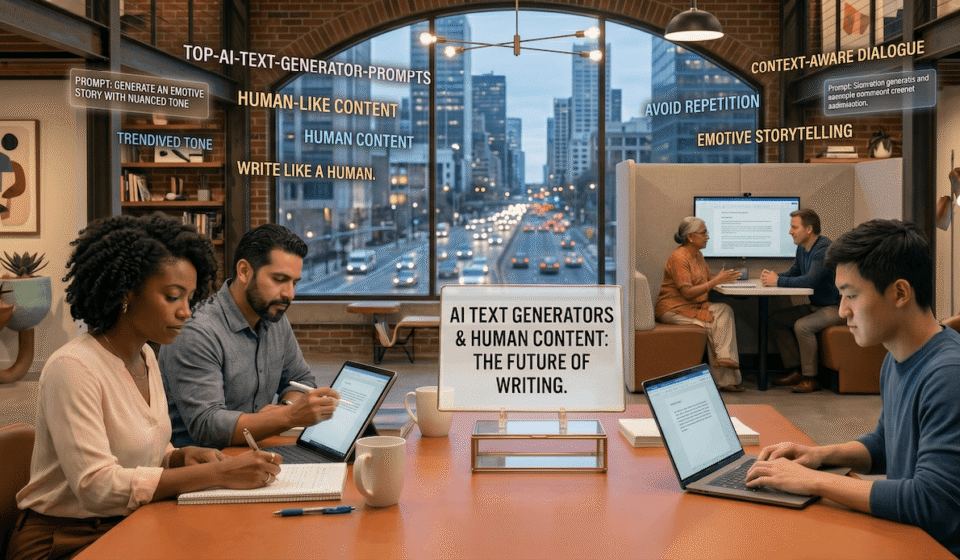

Most people get mediocre results from AI writing tools. Not because the AI is bad. Because their prompts are.
Here is the truth that most “AI content guides” skip: the model is only as good as the instruction you give it. A weak prompt produces weak, robotic content. A well-crafted prompt? That is when things get interesting.
If you have ever copied an AI-generated paragraph into Google Docs and felt that something is off, you know exactly what I mean. The words are technically correct, but they feel hollow. There is no texture, no personality, no real opinion. The good news is that this is almost always a prompt problem, not a model problem.
This article breaks down the best AI text generator prompts that consistently produce human-like, high-quality content, along with why they work, what to avoid, and how to build your own prompt system.
Why Most AI Prompts Fail (And What You Are Missing)
The average user types something like: “Write a blog post about productivity tips.”
That instruction gives the AI almost nothing to work with. No audience. No tone. No format. No angle. The model fills in those blanks itself, usually with the most generic version it can generate.
Compare that to this:
“Write a 600-word blog section for early-stage startup founders who are overwhelmed by task overload. Use a direct, slightly punchy tone. Start with a short anecdote. Avoid corporate jargon. Make it feel like advice from a trusted peer, not a consultant.”
The second version produces something completely different. That is the difference between a basic prompt and a top AI text generator prompt.
What Makes a Prompt Produce Human-Like Content
Before jumping into specific examples, here are the four elements that separate robotic output from authentic-sounding content.
Persona and role: Tell the AI who it is. “Act as a senior content strategist with 10 years in B2B SaaS” performs better than no role at all.
Audience definition: Be specific about who the reader is. Busy freelancers respond differently than corporate executives. The AI needs to know.
Tone and style markers: Words like “conversational,” “dry humor,” “direct,” or “warm but professional” shape the entire writing style.
Format instructions: Tell it whether you want bullet points, short paragraphs, a narrative structure, or a listicle. Structure affects how human the final content feels.
Top AI Text Generator Prompts That Actually Work
Here are battle-tested prompts across different content types, along with why each one works.

For Blog Introductions
“Write a blog introduction for [topic]. The reader is a [audience type] who is skeptical about [common misconception]. Open with a short, grounded observation, not a question. Keep it under 100 words and avoid starting with ‘In today’s world’ or ‘Are you struggling.'”
Why it works: It removes the most overused AI openers and forces a more original angle.
For Product Descriptions
“You are a copywriter for a premium [product category] brand. Write a 3-sentence product description for [product name]. The tone is confident, slightly understated, and speaks to someone who values quality over trends. No superlatives.”
Why it works: Banning superlatives like “best,” “amazing,” and “revolutionary” immediately makes copy sound less like AI and more like editorial writing.
For LinkedIn Posts
“Write a LinkedIn post from the perspective of a founder who just learned a hard lesson about [topic]. First-person, honest, no hashtags in the body, one call to reflection at the end. Max 180 words.”
Why it works: First-person + vulnerability + character constraints produce posts that feel personal rather than promotional.
For Email Subject Lines
“Generate 10 email subject lines for a campaign about [offer or topic]. Audience: [type]. Mix styles: curiosity gap, direct benefit, personal question, and one that sounds like it came from a friend. No emojis.”
Why it works: Asking for mixed styles forces variety. The “sounds like a friend” instruction pulls the model toward conversational language.
Pros and Cons of Prompt-Driven AI Writing
Pros
- Dramatically reduces editing time when prompts are well-built
- Scales content production without losing brand voice
- Allows non-writers to produce structured, readable content
- Easily customizable for different audiences and formats
Cons
- Requires upfront investment in prompt design
- Still needs human review for accuracy and facts
- Over-reliance can reduce original creative thinking
- Prompt quality varies by user experience level
Common Mistakes to Avoid
Even experienced users fall into these traps.
Being too vague. “Write something engaging” means nothing to an AI model. Engaging to whom? In what context?
Forgetting the negative space. Tell the AI what NOT to do. “Avoid clichés,” “don’t use passive voice,” “skip the motivational language” – these constraints matter.
Ignoring output length. If you do not specify length, AI tends to over-write. Always define a word or sentence count.
Skipping the persona layer. Roleless prompts produce generic content. Give the AI a character to inhabit, even a simple one.
Best AI Tools for Prompt-Based Writing
| Tool | Best For | Strength |
|---|---|---|
| ChatGPT (GPT-4o) | General content, long-form | Versatile, strong reasoning |
| Claude (Sonnet/Opus) | Nuanced tone, structured writing | Human-like voice |
| Gemini Advanced | Research-backed content | Real-time web access |
| Jasper AI | Marketing copy, brand voice | Template library |
| Perplexity AI | Cited, factual content | Source attribution |
Future of AI Text Generation
Prompt engineering as a standalone skill is already starting to evolve. In 2026 and beyond, AI tools are getting better at inferring intent from shorter instructions, which means the future is less about crafting perfect prompts and more about building systems. Think prompt libraries, shared templates, and AI agents that auto-refine prompts based on feedback loops.
That said, the best AI text generator prompts will always have one thing in common: they are written by someone who deeply understands the audience. That human layer is not going away anytime soon.
Conclusion: Start With Better Inputs
If your AI content sounds robotic, the fix is almost never the model. It is the prompt. Start by defining the persona, audience, tone, and format before you write a single instruction. Test, iterate, and build a personal library of prompts that consistently produce the output you want.
The best AI writing is not about replacing human thinking. It is about extending it.
FAQ Section
Q: What is a top AI text generator prompt? A top AI text generator prompt is a detailed, structured instruction given to an AI model that includes role, audience, tone, format, and constraints, designed to produce natural, human-sounding content.
Q: How do I make AI-generated content sound more human? Use persona-based prompts, define your audience precisely, include tone markers, ban overused phrases, and always set a clear format. Iterating on prompts over time improves results significantly.
Q: What is the best AI text generator in 2025? ChatGPT (GPT-4o), Claude, and Gemini are the leading options depending on your use case. Claude tends to perform well for nuanced, human-like writing while ChatGPT excels at versatility.
Q: Can prompt engineering replace a professional writer? Not entirely. Prompt engineering is a productivity tool that enhances output speed and structure, but human oversight for accuracy, original perspective, and brand judgment remains essential.
Q: How long should an AI writing prompt be? There is no fixed rule, but effective prompts typically range between 50 to 150 words. The goal is enough context for the AI to make informed decisions without overloading it with contradictory instructions.