

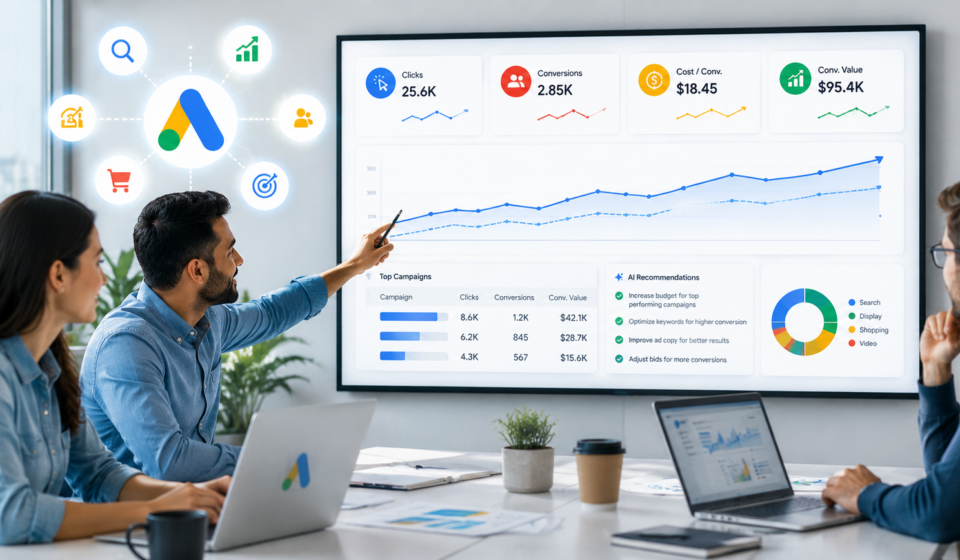
How AI Improves Google Ads Performance – And Why Most Advertisers Are Still Leaving Money on the Table

I ran a Google Ads campaign for three months without touching the bidding strategy. The results were fine – not terrible, not great. Clicks came in, some converted, most did not. Then I switched on Google’s AI-powered Smart Bidding and connected it to actual conversion data. Within two weeks, the cost per conversion dropped by 34%.
That is not a case study from a whitepaper. That is what happened when I stopped guessing and let the machine do what it is actually good at.
This piece is not about handing your ad account over to a robot and hoping for the best. It is about understanding exactly where AI fits into a Google Ads workflow, what it genuinely improves, and where human judgment still matters more than any algorithm.
Why Google Ads Has Always Been an AI Problem in Disguise
Google Ads is not just about writing good copy and picking the right keywords. It is about making thousands of micro-decisions every single day – who sees your ad, when, at what bid, against which competitor, on which device, in which location, at what time.
No human can manage all of that manually at scale. Advertisers who tried to do it that way five years ago were already guessing. The difference now is that the AI tools available to manage those decisions are genuinely good, and the gap between advertisers who use them well and those who ignore them is growing every quarter.
If you have read our piece on how AI tools are transforming digital marketing, you already know that AI is not a trend – it is the baseline. In paid advertising, that shift happened faster than almost anywhere else.
What AI Actually Does Inside Google Ads
There are five areas where AI makes a measurable difference in campaign performance.
Bidding decisions – this is where the biggest gains tend to come from. Smart Bidding uses machine learning to set bids in real time based on signals like device type, location, time of day, search history, browser, and hundreds of other factors that manual bidding cannot factor in simultaneously. Target CPA and Target ROAS bidding strategies work by analyzing your historical conversion data and optimizing every auction toward the outcome you care about.
Audience targeting – Google’s AI identifies users who are most likely to convert based on behavioral patterns, not just demographics. Audience expansion and similar segments use this to find people who look like your existing converters but have not seen your ads yet.
Ad copy and responsive search ads – when you feed Google multiple headlines and descriptions, the system tests combinations and learns over time which pairings perform best for different users and queries. It is not perfect, but it removes a lot of the manual A/B testing work that used to take months.
Search term matching – broad match has become significantly more useful now that it is powered by AI. The system understands intent, not just keyword overlap. A search for “best running shoes for flat feet” can trigger an ad for “orthopedic athletic footwear” if the AI determines the intent matches. This would have been a wasted impression five years ago.
Performance Max campaigns – these are Google’s most AI-heavy campaign type. You provide creative assets, your conversion goal, and some audience signals. The AI handles placement, bidding, targeting, and optimization across Search, Display, YouTube, Discover, Gmail, and Maps. The lack of visibility can be frustrating, but for many advertisers running these alongside Search campaigns, the results have been consistently strong.
The Part Most Advertisers Get Wrong
AI in Google Ads is not a set-it-and-forget-it solution. It is more like a new hire who learns fast but needs good training data and clear direction.
The most common mistake is giving Smart Bidding a goal to optimize toward before there is enough conversion data to work with. Google recommends at least 30 conversions per month in a campaign before switching to Target CPA bidding. Without that data, the algorithm is essentially guessing, and it will be wrong more often than it should be.
The second mistake is treating the AI as a replacement for strategy. AI handles execution. It does not tell you whether you are targeting the right audience in the first place, whether your landing page matches your ad promise, or whether your offer is competitive. Those are human decisions.
We covered a related idea in our article on AI tools for affiliate marketers – the tools amplify whatever strategy you bring in. Strong strategy plus AI equals strong results. Weak strategy plus AI equals faster losses.
Keyword Strategy in the Age of AI
Keywords are still important, but the relationship between keywords and campaigns has fundamentally changed.
Exact match used to mean your ad only showed for that precise phrase. Now even exact match allows for close variations that Google’s AI determines to be equivalent in intent. This gives you less control but more reach, which is a trade-off that tends to work well for advertisers with good conversion tracking in place.
The smarter approach today is to use keywords primarily to communicate intent signals to the AI, not to control every possible query match. You pick themes and anchor terms. You use negative keywords aggressively to exclude irrelevant traffic. You review your search terms report regularly and feed that information back into the campaign structure.
This is more like editing and directing than it is like manual management. The AI handles the detail work. You handle the direction.
How AI-Generated Ad Copy Actually Performs
Responsive Search Ads were controversial when they launched because advertisers felt like they were losing control of their messaging. That concern was reasonable. But the performance data since then has been consistent – RSAs generally outperform static Expanded Text Ads, and the gap widens over time as the algorithm learns.
The key is writing inputs that the AI can mix well. If all your headlines say essentially the same thing in slightly different words, the algorithm does not have much to work with. You want variety – a headline that leads with the benefit, one that leads with the offer, one that asks a question, one that includes a number or data point. The AI will test the combinations and surface what resonates.
Tools like Google’s own asset strength indicator give you a signal of how much variety you have in your creative inputs. Aim for Excellent. If you are stuck at Poor or Average, the AI cannot do its job properly regardless of how good your bidding strategy is.
Reading the Data Differently When AI Is Involved
When AI is managing your bids and targeting, the metrics you monitor need to shift slightly.
- Click-through rate matters less than conversion rate and cost per conversion
- Impression share becomes more meaningful as a signal of whether your budget is limiting the AI
- Quality score still reflects relevance and landing page experience – AI cannot fix a bad user experience
- Search terms reports need regular review to catch irrelevant matches and find new keyword ideas
The Google AI Mode guide we published recently goes deeper into how Google’s AI is reshaping search results overall – which has a direct effect on what users see before they even click an ad.
Where Human Judgment Still Matters
AI is genuinely impressive at optimization within a defined objective. It is not good at stepping back and asking whether the objective itself is right.
If your campaign is optimizing for lead form fills but most of those leads never convert to actual customers, the AI will get very good at generating useless leads. It has no way to know that unless you feed it closed-won data from your CRM, which most advertisers do not do.
Human oversight matters for:
- Setting the right conversion goals and values
- Deciding when a campaign strategy needs to change, not just optimize
- Evaluating whether the creative is on-brand and building something worth trusting
- Identifying seasonal shifts or competitive changes that the AI has not had time to learn yet
- Asking whether you are in the right channel at all
The advertisers getting the best results from AI-assisted Google Ads are not those who hand everything over. They are the ones who understand what the AI does well, give it clean data and clear goals, and stay in the loop on strategy.
A Practical Place to Start
If you are running Google Ads now and not using Smart Bidding, start there. Switch a campaign with at least a few months of conversion data to Target CPA or Target ROAS and give it four to six weeks without major interference. The algorithm needs time to learn.
If you are not tracking conversions properly, fix that first. AI bidding without conversion data is expensive noise.
If you are already using Smart Bidding but not seeing results, the problem is almost always in one of three places – not enough conversion data, a conversion goal that does not match your actual business outcome, or a landing page that is losing people before they take action.
For a broader look at how AI is changing marketing across channels, the AI in Marketing category on our site has a growing library of practical pieces. And if you are thinking about how AI fits into your overall toolkit, our roundup of top AI SEO tools shows how paid and organic strategies increasingly share the same AI-powered infrastructure.
Final Results
Google Ads has always rewarded people who make better decisions faster. AI does not remove the need for good decisions – it raises the stakes for them. When the algorithm is handling thousands of micro-optimizations every day, the impact of your high-level choices – the right audience, the right offer, the right goal – is amplified, not reduced.
The advertisers who will win over the next few years are not the ones who distrust AI tools or the ones who rely on them blindly. They are the ones who understand what each side of that partnership is actually good at.
Start with clean data. Set real conversion goals. Let the AI handle execution. Keep your hands on strategy.
That is where the performance gap actually lives.
Explore more from AI Overview Search: